

Table of Contents
- Why Online Clothing Prices Fluctuate So Frequently
- How to Spot Fake Online Clothing Stores
- Understanding Retail Markup and Pricing Strategies
- Quality vs. Price Correlation: What You Actually Pay For
- Online Shopping Consumer Protection Tips
- Average Cost of Quality Clothing and Value Assessment
- Red Flags That Signal Unreliable Pricing
- How to Verify Online Prices Are Legitimate
Last Updated: August 25, 2026
Why Online Clothing Prices Fluctuate So Frequently
Online clothing prices shift constantly due to demand spikes, supply chain changes, competitor moves, and seasonal shifts. Retailers use dynamic pricing algorithms that adjust prices in real time based on inventory levels, competitor pricing, and demand signals. A sweater that costs $45 on Monday might be $39 by Wednesday if sales are slow, or jump to $55 if inventory is low and demand is high.
Fast fashion brands amplify this volatility by rotating inventory aggressively. The pressure to move merchandise creates pricing pressure, with discounts appearing and disappearing within days. This rotating inventory model, which Republic Mercantile also employs to keep offerings fresh, creates real value for shoppers willing to act, but prices are inherently less stable than traditional retail.
Seasonal factors drive predictable fluctuations: winter coats drop in price as spring approaches, summer dresses get marked down in August. However, retailers also use artificial scarcity tactics, limited-time sales, flash discounts, and countdown timers that create false urgency. Learning to distinguish between genuine seasonal adjustments and manufactured pressure is critical.
How to Spot Fake Online Clothing Stores
Fraudulent clothing retailers have become sophisticated, but they leave traces. The most reliable way to identify a fake store is to examine multiple data points simultaneously.
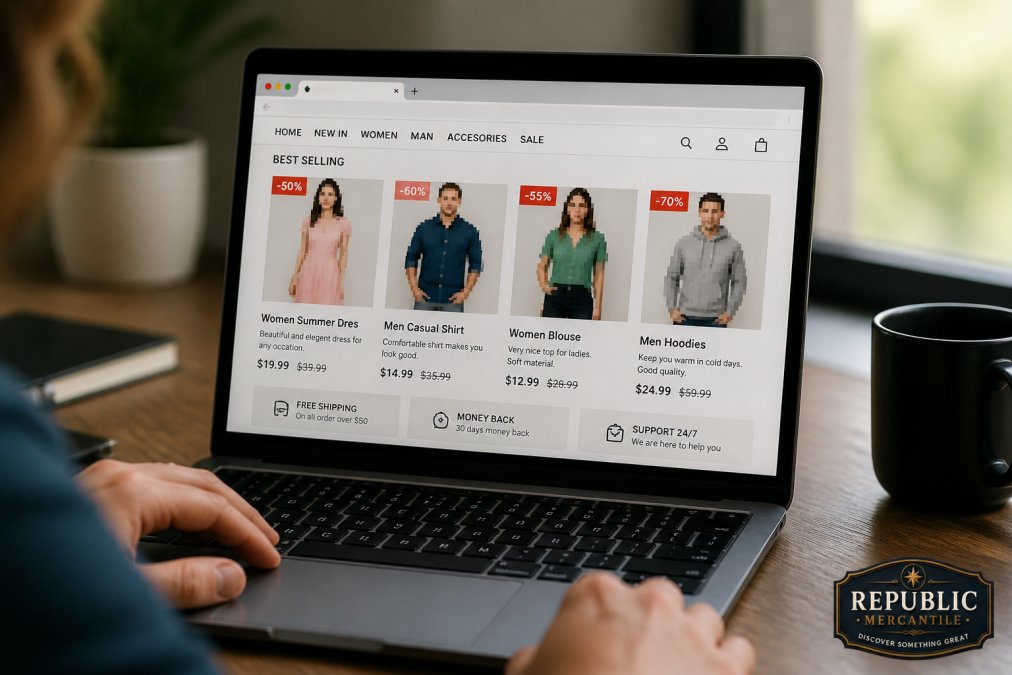
Start with the website itself. Legitimate retailers invest in professional design. Fake stores display telltale signs: blurry or obviously stolen product photos, inconsistent branding, poor grammar in product descriptions, and clunky navigation. Check the URL carefully, scammers register domains that closely mimic legitimate retailers (like "amazoon.com" instead of "amazon.com").
Payment security matters tremendously. Look for an HTTPS connection (the padlock icon in your browser) and verify that checkout uses a secure payment gateway. Legitimate retailers display trust badges from services like Norton Secure, McAfee Secure, or payment processors like Stripe and PayPal.
Review the return policy carefully. Legitimate retailers clearly state their return windows, shipping costs, and process. Fake stores either have no return policy or make it deliberately difficult to find.
Research the company's reputation independently. Search the store name plus "scam" or "reviews" and look for patterns. Check the Better Business Bureau and FTC complaint database. A few negative reviews is normal; dozens of complaints about non-delivery, counterfeit goods, or refund denials is not.
Contact information transparency is a strong indicator of legitimacy. Fake stores often list a generic Gmail address or no contact method at all. Legitimate retailers provide a physical address, phone number, and multiple contact channels.
Understanding Retail Markup and Pricing Strategies
Retail markup is the difference between what a retailer pays for an item and what they charge customers. A typical retail markup in clothing ranges widely depending on the brand and category. Budget retailers operate on lower markups because they compensate with volume. Premium brands maintain higher markups. This isn't inherently deceptive; it's how retail economics work.
Price-matching policies create competitive pressure that benefits consumers. When retailers commit to matching competitor prices, it creates an incentive to stay competitive. Republic Mercantile's competitive pricing reflects this broader market dynamic. However, price-matching policies often have fine print: the competitor's price must be current and active, the product must be identical, and the competitor must be an authorized retailer.
Psychological pricing strategies influence how retailers set prices. Prices ending in .99 feel cheaper than round numbers. Bundle pricing makes customers feel like they're getting a deal when they're actually paying full price for each item. Recognizing these tactics helps you evaluate prices more objectively.
Clearance pricing and inventory liquidation represent genuine opportunities. When retailers need to clear old inventory to make room for new stock, prices drop significantly. Republic Mercantile's rotating inventory model means older items get marked down to make room, creating real value for budget-conscious shoppers.
Quality vs. Price Correlation: What You Actually Pay For
The assumption that higher prices mean better quality is intuitive but incomplete. In online clothing retail, the relationship between price and quality is complex and often misleading.
Material composition matters more than price alone. A $30 cotton shirt with a high thread count can outlast a $60 polyester blend. Check the fabric content listed in product descriptions. Natural fibers typically last longer than synthetics, but they require more careful care. Blended fabrics often represent a compromise: durable, easy-care, and affordable.
Construction quality is harder to assess online but critical to durability. Seam strength, hem quality, and reinforcement in stress points determine how long a garment lasts. Reading detailed customer reviews often reveals construction issues. If multiple reviewers mention seams coming apart after a few washes, that's a quality problem the price doesn't justify.
Brand reputation influences price but doesn't guarantee quality. Established brands charge premiums partly because of brand equity, not just superior quality. A lesser-known brand might produce equally durable clothing at a lower price point.
Cost-per-wear is a useful framework for evaluating clothing value. A $80 winter coat worn 100 times costs $0.80 per wear. A $30 trendy shirt worn 5 times costs $6 per wear. From this perspective, the expensive coat is the better value.
Online Shopping Consumer Protection Tips
Federal consumer protection laws establish baseline rights for online shoppers, though enforcement often falls on the consumer to initiate.

The Federal Trade Commission enforces rules around online commerce. According to FTC guidance on online shopping, retailers must clearly disclose material terms before charging your payment method, including total cost, shipping charges, and return policies.
Return policies are your primary protection mechanism. A 30-day return window is standard for most retailers. Read the policy before purchasing. Key details include whether return shipping is free or paid, whether items must be unworn and in original packaging, and how refunds are processed. Republic Mercantile's return policy should be clearly stated on their website.
Payment methods offer different protections. Credit cards provide chargeback rights if goods don't arrive or are misrepresented. Debit cards offer fewer protections. Using credit cards for online purchases gives you an additional layer of recourse.
Keep records of all transactions. Save confirmation emails, order numbers, tracking information, and any communication with customer service. Screenshots of product descriptions and pricing are particularly valuable if an item doesn't match what was advertised.
Report fraudulent activity promptly. If you're scammed, report it to the FTC at FTC complaint submission. Report to your payment processor and bank immediately.
Average Cost of Quality Clothing and Value Assessment
Establishing realistic price expectations helps you evaluate whether online clothing prices are reliable.
Basic everyday essentials, plain t-shirts, basic jeans, simple sweaters, typically range from $15-$40 depending on material and brand. Items at the lower end are often fast fashion designed for short-term wear. Mid-range items ($25-$35) often represent better durability and material quality.
Mid-tier branded clothing generally ranges from $40-$100. This category includes established brands with decent quality standards. Items in this range typically use quality materials and construction suitable for regular wear over multiple seasons.
Premium and designer clothing starts around $100 and goes significantly higher. At this price point, you're paying for brand reputation, design, and often superior materials and construction.
Seasonal variations create legitimate price fluctuations. Winter coats cost more during winter and less during summer. This seasonality is predictable and reliable.
Discount retailers and outlet channels offer lower prices because they sell overstock, previous-season items, or items with minor defects. These prices are reliable, reflecting genuine cost reduction.
Red Flags That Signal Unreliable Pricing
Certain pricing patterns indicate that online clothing prices may not be reliable or that the retailer may not be trustworthy.
Prices that remain permanently discounted are suspicious. If everything in a store is marked "50% off" or "clearance," the original prices were likely inflated. Legitimate retailers have items at full price most of the time.
Countdown timers and artificial scarcity create pressure designed to bypass rational evaluation. "Only 3 items left!" and "Sale ends in 2 hours!" are psychological tactics. If you see multiple items with "only 2 left" messages, that's likely a scripted tactic.
Prices that fluctuate wildly without explanation are concerning. A $40 shirt jumping to $60 and back to $30 within a week suggests pricing manipulation rather than market-based adjustments.
Inconsistent pricing across similar items is a red flag. If identical shirts in different colors are priced at $25, $35, and $45 with no explanation, that suggests either pricing errors or manipulation.
Free shipping offers that seem too good to be true often are. When shipping is genuinely free, the cost is built into the product price. Compare total cost, not just the advertised price.
Retailers that refuse to disclose material composition or construction details are problematic. Legitimate retailers provide detailed product information.
How to Verify Online Prices Are Legitimate
Verifying that online clothing prices are reliable requires cross-referencing multiple data points.
Use price comparison tools to track pricing over time. If an item shows a consistent $40 price with occasional $35 sales, that pricing pattern is likely genuine. If an item jumps from $70 to $20 with "limited time" messaging, that's suspicious.
Cross-reference prices across multiple retailers. If an item is $40 at one retailer and $25 at another, investigate why. Different retailers have different margins and business models.
Research the brand's official pricing recommendations. Most established brands publish suggested retail prices (MSRP). If a retailer's price is significantly below MSRP with no clear reason, verify the item is authentic.
Check for authentic product codes and identifiers. Legitimate clothing items have tags, care labels, and often product codes or QR codes. Counterfeit items often lack these or have poor-quality reproductions.
Read customer reviews specifically for authenticity concerns. If multiple reviewers mention receiving counterfeit items or items that don't match descriptions, that's a serious red flag.
Verify the retailer's business registration and physical address. Use Better Business Bureau search to verify business registration and complaint history.
Contact customer service with specific questions before purchasing. Ask about material composition, sizing, return policies, and shipping timeframes. Legitimate businesses provide detailed, helpful answers.
Evaluating whether online clothing prices are reliable ultimately comes down to developing skepticism without becoming paranoid. Prices fluctuate for legitimate reasons: seasonal demand, inventory levels, competitive pressure, and market dynamics. However, predatory pricing, counterfeit goods, and outright fraud also exist online. The retailers you can trust are those with transparent pricing, clear policies, and responsive customer service.
At Republic Mercantile, we maintain competitive pricing on everyday essentials, clothing, jewelry, and collectibles through efficient operations and high-volume sales. Our rotating inventory keeps prices fresh and competitive. Fast shipping and clear return policies mean you can shop with confidence. Consumer Reports shopping guide provides additional frameworks for evaluating online retailers.
Frequently Asked Questions
How can you tell if an online clothing store is legitimate?
Check for secure payment gateways (HTTPS), clear return policies, detailed product descriptions with multiple photos, customer reviews from verified buyers, and legitimate contact information. Verify the brand reputation through consumer advocacy sites and the Better Business Bureau. Avoid sites with poor website design, generic product images, or vague shipping transparency details. Legitimate retailers display business registration information and clear terms of service.
Why do online clothing prices fluctuate so frequently?
Online retailers adjust prices based on inventory levels, demand fluctuations, seasonal trends, and competitive pricing. Fast fashion creates price volatility as new stock arrives constantly. Price-matching policies and clearance pricing for older inventory also drive frequent changes. Supply chain costs and market saturation in specific categories influence pricing strategies. Subscription models and flash sales add another layer of price variability that traditional retail doesn't experience.
What is the average cost of quality clothing when shopping online?
Quality clothing prices vary by material composition, brand reputation, and garment durability. Mid-range quality pieces typically range from $30 to $100 per item, while premium options exceed $150. Cost-per-wear calculations help evaluate value, a $60 shirt worn 50 times costs $1.20 per wear. Sustainable wardrobe pieces may cost more upfront but offer better durability and value.
What red flags indicate a fake or unreliable online clothing retailer?
Watch for counterfeit goods warnings, prices significantly below market rates, missing secure payment gateways, no clear return policy, poor customer reviews mentioning quality issues, and vague shipping transparency. Fraudulent websites often have spelling errors, generic product photos, no physical address, and unresponsive customer service. Be cautious of sellers offering inventory liquidation at prices too good to be true, this often signals counterfeit merchandise. Verify the business through consumer protection agencies before purchasing.
This article was written using GrandRanker