

Table of Contents
- The Real Trade-offs of Buying Clothes Online
- How to Measure Yourself for Online Clothes Shopping
- How to Spot Quality Clothing Online
- Best Practices for Online Clothing Returns
- The Hidden Costs: Shipping, Returns, and Decision Fatigue
- When Online Shopping Wins (and When It Doesn't)
- Making the Decision: A Framework for Smart Shopping
- Frequently Asked Questions
Last Updated: September 19, 2026
The Real Trade-offs of Buying Clothes Online
Is buying clothes online worth it? It depends on what you're willing to sacrifice. When you shop for clothes online, you trade the ability to touch fabric, see true colors, and try items on immediately for convenience, wider selection, and often better prices. The real question is whether these trade-offs align with how you shop and what you need.
Many shoppers find convenience justifies ordering from home, especially with busy schedules. However, hidden costs of shipping, returns, and decision fatigue often catch people off guard. Savvy shoppers need to weigh these factors carefully before committing to an online-first wardrobe strategy.
The decision hinges on a few key variables: your tolerance for returns, your ability to assess quality without physical inspection, your budget for potential shipping costs, and whether you're buying staples you already know fit or experimenting with new styles and brands.
How to Measure Yourself for Online Clothes Shopping
Accurate measurements prevent most sizing problems. Before ordering, measure yourself properly, this single step prevents most returns.
Use a soft measuring tape in a well-lit area wearing minimal clothing. For tops, measure chest at the fullest point and sleeve length from center back neck to wrist. For pants, measure inseam from inside thigh to ankle bone while barefoot.
Write down these measurements and compare them against the size guide on each retailer's website before ordering. Size guides vary dramatically between brands, what's a medium at one retailer might be a large at another. This variation is one of the most common reasons online clothing purchases disappoint.
A garment's cut, fabric weight, and silhouette influence how it drapes. When buying clothes online, you can't adjust for these variables in a fitting room, so detailed product descriptions and customer reviews are essential.
How to Spot Quality Clothing Online
Assess garment quality by examining product photography for detailed shots showing fabric texture, weave patterns, and seam construction. Quality manufacturers provide multiple angles and close-ups. If a retailer only shows flat lays or distant shots, that's a red flag.
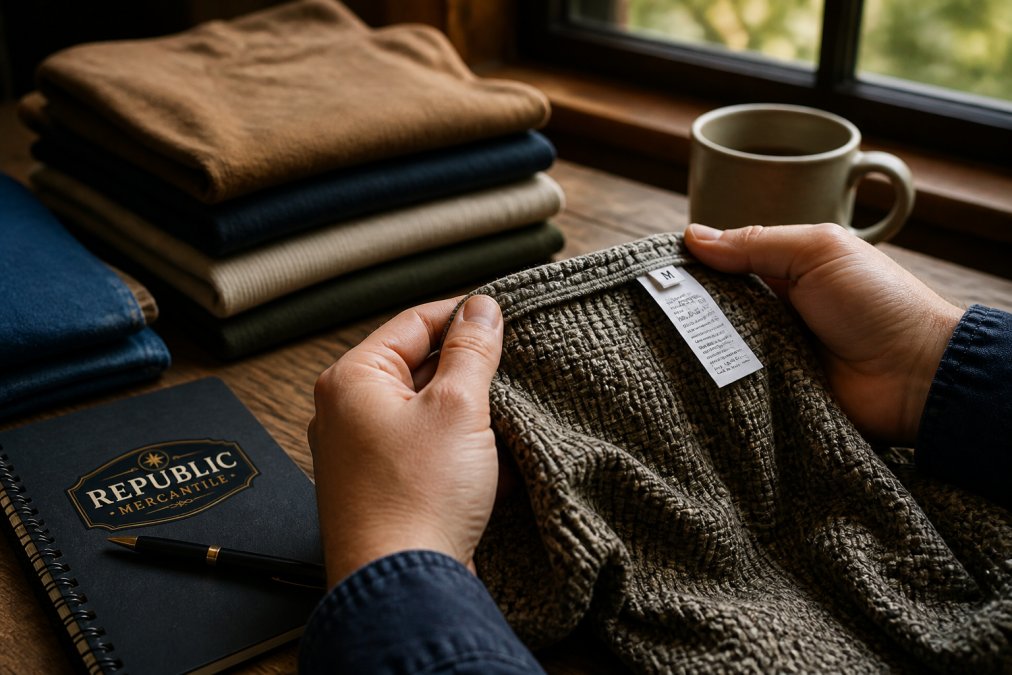
Decoding fabric composition to predict performance
The fiber content label is your most reliable proxy for quality and performance when you can't touch fabric. Each fiber type behaves predictably:
Natural fibers (cotton, linen, wool, silk) breathe well and improve with age but wrinkle easily and may shrink. A 100% cotton t-shirt softens after washing; linen develops a lived-in texture, features, not flaws.
Synthetic fibers (polyester, nylon, acrylic, spandex) resist wrinkles and shrinkage but don't breathe as well and pill more easily.
Blends offer compromise. A 60% cotton, 40% polyester blend provides wrinkle resistance while maintaining breathability, but performance depends entirely on the ratio.
When reading a fiber content label online, look for the percentage breakdown. If a product lists "65% polyester, 35% cotton," the polyester dominates the garment's behavior, expect it to hold its shape well but potentially feel less soft than pure cotton.
Fabric weight is critical. Heavyweight cotton (200+ gsm) holds shape better and resists pilling; lightweight (150 gsm or below) feels delicate and tears easily. For everyday wear, aim for mid-weight (170-190 gsm).
Thread count matters for woven fabrics: higher counts (400+) indicate tighter weaves, but anything above 800 is marketing hype. For clothing, fiber quality and fabric weight matter more.
Weave type affects durability. Twill weave is more durable and wrinkle-resistant than plain weave. Jersey knit stretches; rib knit is tighter. Specified weave types indicate manufacturer confidence.
Reading care instructions as a quality signal
Care labels reveal durability expectations. "Dry clean only" requires professional cleaning ($3-$8 per item) and limits wear frequency. "Machine wash cold, lay flat to dry" signals everyday durability and better long-term value.
Red flags: "hand wash only" suggests delicate construction; "do not bleach" and "do not tumble dry" indicate fragile fabric; "color may bleed" requires separate washing.
Conversely, "machine wash warm, tumble dry" signals a garment built for durability and minimal fuss. This care profile typically correlates with better quality construction because manufacturers only recommend aggressive washing for fabrics that can handle it.
Using customer reviews to validate quality claims
Customer reviews provide real-world durability data. Look beyond star ratings for specific comments about performance after multiple washes and wears.
Look for patterns: multiple mentions of running small likely means it does; pilling after a few washes indicates low-quality fiber or loose weave; consistent praise for durability and fit accuracy is strong evidence the item is worth ordering.
Authentic feedback includes details about washing frequency and longevity. "Seams came apart after three washes" signals poor construction; "fabric feels substantial and hasn't faded after 20 washes" indicates quality.
Skeptical of generic reviews like "Great product!" Specific observations like "fits true to size and fabric feels substantial" indicate actual use.
Assessing construction quality from product images
When examining product photos, look for these construction details that separate quality garments from cheap ones:
Seams: Quality garments show straight, even seams. Flat-felled seams (two parallel stitching lines) on stress points are more durable than single-stitched.
Hems: Finished hems (not raw-edged) indicate durability. Rolled hems on lightweight and topstitched hems on heavy fabrics signal quality.
Collar and cuff construction: Reinforced collars and cuffs maintain shape. Limp, unstructured collars will look sloppy after washing.
Button attachment: Quality uses buttons sewn through multiple layers with back reinforcement. Cheap garments use thin plastic buttons glued or loosely sewn.
Zipper quality: Metal zippers outlast plastic. YKK is the industry standard; off-brand zippers fail more frequently.
If product photos lack close-up construction details, request them or shop elsewhere.
Best Practices for Online Clothing Returns
Understand return policies before buying. Some offer free returns; others charge restocking fees or require you to cover return shipping. These costs add up quickly.
Check whether returns are by mail (convenient, slower) or in-store (immediate, requires trip). Return windows vary from 30 to 90 days, longer windows offer more flexibility.
Follow return processes exactly: include all tags and packaging, photograph shipments for proof, and keep tracking numbers until refund posts. Most return problems stem from incomplete returns.
Every returned item travels through reverse logistics, consuming fuel and generating emissions. Being selective about orders reduces returns and environmental impact.
The Hidden Costs: Shipping, Returns, and Decision Fatigue
Online shopping carries three hidden costs: shipping fees, return logistics, and decision fatigue. Understanding each transforms whether online shopping saves money.
Direct shipping costs and minimum-purchase traps
Shipping costs can eliminate price advantages. A $5 cheaper shirt costs $8 more with standard shipping ($5-$12). Free shipping thresholds ($50-$100) incentivize unplanned purchases.
Calculate true cost: (item price) + (shipping) − (discounts) = actual cost. If an item costs $25 with $8 shipping but free shipping starts at $50, adding $20 in unwanted items creates a 40% markup.
Tiered shipping: standard ($5-$8, 5-7 days), expedited ($12-$18, 2-3 days), overnight ($25+).
Return shipping fees and reverse logistics costs
Return shipping fees ($5-$10) are a silent killer of value. If you return 30% of orders, costs compound quickly.
The environmental cost of returns: Reverse logistics and carbon footprint
Every returned item travels through reverse logistics from customer to warehouse to liquidation or landfill, generating significant environmental impact rarely quantified in online shopping.
Decision fatigue and the cost of choice overload
Decision fatigue is overlooked in online shopping costs. Infinite options, endless scrolling, conflicting reviews, and visualization drain mental energy. Many shoppers buy more than intended because decision-making feels overwhelming.
Calculating true cost per item
True cost = (item price) + (outbound shipping) + (probability of return × return shipping cost) − (discounts)
When Online Shopping Wins (and When It Doesn't)
Online shopping excels when you know your exact size and brand fit. Buying staples you've purchased before, same jeans, same t-shirt in different colors, is ideal. You know the fit, so returns are unlikely.
Making the Decision: A Framework for Smart Shopping
Evaluate these factors: (1) Risk tolerance for returns, if costly or hassle, be more confident before ordering. (2) Sizing knowledge, familiar brands are lower-risk. (3) True cost including shipping and returns. (4) Buying staples vs. new styles, staples are safer online. (5) Time value, is home shopping convenience worth more than in-person time savings? (6) Sustainability, multiple returns with high return rates may outweigh convenience benefits.
| Decision Factor | Online Shopping Advantage | In-Store Shopping Advantage |
|---|---|---|
| Known sizes and brands | Strong advantage | Neutral |
| Experimenting with new styles | Disadvantage | Strong advantage |
| Time availability | Strong advantage | Disadvantage |
| Budget for returns | Advantage (free returns) | Strong advantage (no returns) |
| Selection availability | Strong advantage | Disadvantage |
| Sensory evaluation | Disadvantage | Strong advantage |
Frequently Asked Questions
How can you accurately determine your size when shopping for clothes online?
Use the retailer's size guide and measure yourself at key points: bust, waist, hips, and inseam. Compare your measurements directly to the product dimensions listed, not your usual store size. Many brands vary in fit consistency, so check customer reviews mentioning fit accuracy before purchasing. Virtual try-on technology, when available, can also help confirm whether a garment will fit your body type.
What are the primary downsides of buying clothes online?
The main challenges include fit accuracy issues, inability to assess material texture and garment quality in person, and the time-intensive process of returns and reverse logistics. Decision fatigue from endless inventory options can lead to impulse buying. Shipping costs and restocking fees reduce savings, and the environmental impact of returns, the carbon footprint of sending items back, adds hidden costs to your purchase.
How do return policies impact the value of online clothing purchases?
Flexible return policies with free or prepaid return shipping significantly improve the value proposition of buying clothes online. Retailers charging restocking fees or requiring customers to pay return shipping effectively increase the true cost of purchases. Before buying, confirm the return window length, whether returns are free, and if there are restocking fees. A generous return policy reduces the financial risk of fit or quality disappointment.
Is it cheaper to buy clothes in-store or online?
Online shopping typically offers lower base prices due to reduced overhead, but shipping costs, potential restocking fees, and the cost of returns can narrow or eliminate savings. In-store shopping eliminates shipping and return logistics but offers less inventory variety and fewer price-comparison opportunities. The financial advantage depends on your return rate, shipping costs at checkout, and whether you qualify for free shipping thresholds or loyalty discounts.