

Table of Contents
- Why Shopping at Independent Boutique Retailers Pays Off
- Unique Products and Curated Selection You Won't Find Elsewhere
- Personalized Service and Knowledgeable Staff
- Why Shop at Small Businesses: The Local Economic Impact
- How to Identify Genuinely Independent Retailers
- Unique Gifts from Small Businesses: Finding Something Personal
- The Trade-Offs: Cost, Convenience, and Sustainability
- Conclusion
- Frequently Asked Questions
Last Updated: October 21, 2026
Why Shopping at Independent Boutique Retailers Pays Off
The benefits of shopping at independent boutique retailers start with a simple fact: every dollar you spend is a vote for the kind of neighborhood you want to live in. This guide from Republic Mercantile breaks down what you actually gain, what you give up, and how to tell a real independent shop from a chain wearing a handmade costume.
An independent boutique retailer is a locally owned store, not part of a national chain, that sells a curated, limited selection of goods. That definition matters because "boutique" has become a marketing word. Plenty of chain stores use it. The ownership structure is what separates the real thing from the imitation.
Below, we'll show you exactly how to spot the difference, what the practical trade-offs are, and where your money goes when you shop small.
What Counts as an Independent Boutique Retailer
Ownership is the dividing line. A genuinely independent shop is owned by an individual, a family, or a small local partnership, and that owner has real decision-making power over what gets stocked.
Independently owned stores typically share three traits:
- Local ownership: the owner lives in or near the community the store serves
- Curated inventory: a limited, hand-picked selection rather than a warehouse catalog
- Direct accountability: you can reach the person who made the buying decisions
A national chain can rent a small storefront and call itself a boutique. It still answers to a corporate buying office hundreds of miles away. That's the difference that shapes everything else on this list.
Unique Products and Curated Selection You Won't Find Elsewhere
Walk into an independent boutique and you'll usually see fewer items than a big-box store carries in a single aisle. That's the point. A small shop can't compete on volume, so it competes on taste.
Owners pick inventory by hand. Many stock local makers, small-batch producers, and short-run collections that never reach national distribution. You get product discovery instead of a wall of the same twelve items every other store carries.
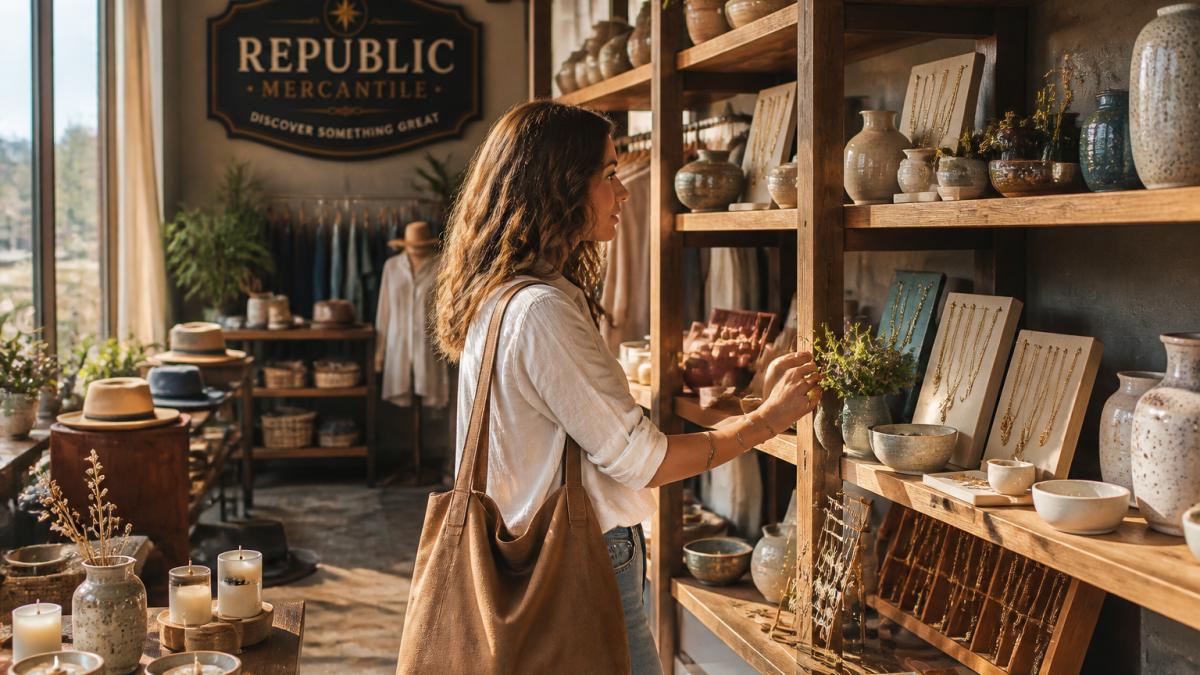
This is where unique gifts from small businesses come from. A curated selection means the owner already did the filtering for you. You're choosing from a shortlist someone with taste assembled, not scrolling through thousands of near-identical listings.
Personalized Service and Knowledgeable Staff
Personal attention is the benefit independent retailers can offer that no warehouse store can match. The person helping you is often the person who chose the product, and sometimes the person who made it.
That changes the conversation. Instead of a scripted answer, you get specifics: which fabric holds up to repeated washing, which piece runs small, which maker ships slowly. Knowledgeable staff shorten the gap between what you want and what you buy.
Customer relationships work differently too. Small-business owners remember repeat customers. Many keep notes on preferences and set items aside. That kind of customer loyalty runs both directions, and it's hard to replicate at scale.
Why Shop at Small Businesses: The Local Economic Impact
Money spent at an independent store stays closer to home. That's the headline, but the useful version of the argument explains how a dollar recirculates, how much of it does, and where the claim gets softer than the slogan suggests.
The mechanism has three parts. First, a locally owned store tends to bank with a local institution, hire from the surrounding labor pool, and buy services, accounting, maintenance, marketing, insurance, from other local businesses.
That's the theory. The measured version is narrower and more honest. Economic-development researchers who study local multipliers, the number of times a dollar re-spends inside a region before leaving, consistently find that locally owned businesses generate a larger local multiplier than national chains in the same sector.
Where the claim gets softer:
- Multipliers are sector-specific. A local bookstore and a local hardware store don't have the same local supply chain, so they don't have the same multiplier.
- Online leakage counts. If a local shop sources most of its inventory from overseas suppliers and ships via national carriers, less of your dollar stays local than the ownership structure alone implies.
- Wages matter more than slogans. The strongest local impact comes from stores that pay competitive wages and buy local services, not just from the ownership label.
Jobs are the part of the argument most often overstated. Independent retailers do create local jobs, but retail jobs at small shops are frequently part-time and hourly, and the pay is often below the local median.
If you want to test the claim on a specific shop, ask three questions: Where does the owner bank? Where do the products come from? Do they use local service providers? The answers tell you more about local impact than any "shop local" sign in the window.
How to Identify Genuinely Independent Retailers
Most shoppers assume they can tell an independent store from a chain at a glance. Usually they can't. Here's how we'd check.
- Look up the ownership: search the business name plus "owner" or check state business registration records
- Count the locations: one store, or a handful in one region, suggests independent ownership
- Check the product mix: a tight, opinionated selection points to a real curator
- Ask directly: "Are you locally owned?" is a fair question, and honest shops answer it fast
- Watch the signage: heavy corporate branding and standardized displays are chain signals
The tells are behavioral, not aesthetic. A shop can look charming and still be a franchise. A plain storefront can be fiercely independent.
Unique Gifts from Small Businesses: Finding Something Personal
Gift shopping is where independent retailers pull ahead. A curated shop solves the hardest part of gifting: finding something the recipient hasn't already seen everywhere.
Independent retailers tend to carry items with a story attached. A hand-thrown mug, a small-batch candle, a piece of jewelry from a regional maker. These read as personal because they are personal. The owner can often tell you who made the item and where.
Product quality and craftsmanship also matter more in a small shop. Owners stake their reputation on what they stock, so they tend to avoid the disposable end of the market. That doesn't guarantee perfection, but it does mean someone with skin in the game vetted the item.
The Trade-Offs: Cost, Convenience, and Sustainability
Independent retail isn't a free lunch, and any guide that pretends otherwise is selling something. The honest version separates the trade-offs you can measure from the ones you can only weigh.
Cost: sticker price versus cost per use
The sticker price at an independent boutique is usually higher than at a chain. That's structural, not greedy. A small shop buys in smaller quantities, so it doesn't get volume discounts, and it can't spread overhead across hundreds of locations. Expect to pay more for the same category of item.
The fair comparison isn't sticker price to sticker price. It's cost per wear or cost per use over the life of the item. A well-made item that lasts several seasons often costs less per wear than a cheap one replaced twice. That math only works if the item actually lasts, so the comparison depends on construction, materials, and repairability, not on the word "boutique."
A practical way to run the comparison:
- Estimate uses. How many times will you wear or use it in a year?
- Estimate lifespan. Will it survive one season, three, or ten?
- Add service costs. Can it be repaired, resoled, or altered locally, and at what cost?
- Divide. Total cost including service, divided by total uses, gives you a number you can compare across stores.
A common pattern is that independent shops win on cost per use for items you'll use heavily and lose on items you'll use rarely. That's a useful rule of thumb, not a guarantee.
Convenience: the real costs
Small shops usually have shorter hours, fewer locations, and narrower return windows than chains. Those are real costs, and they matter more for some purchases than others. A chain's easy returns and bulk buying are genuine advantages for consumables, basics, and anything you need today.
Independent shops often offset this with flexibility: special orders, holds, and direct access to the owner. A small-business owner can order a size or color a chain wouldn't stock, and can often tell you when it will arrive. That flexibility is worth more for considered purchases than for everyday ones.
Sustainability: a trade-off, not a guarantee
Short production runs mean less dead stock and less overproduction, which is a real environmental advantage. But "local" doesn't automatically mean "low impact." A locally owned shop still ships goods, still generates packaging waste, and may source from the same overseas factories as a chain. The sustainability advantage depends on sourcing, packaging, shipping distance, and product longevity, not on the ownership label alone.
Ask where products come from, how they're packaged, and whether the shop offers repair or take-back. Those answers tell you more than the word "sustainable" on a sign.
The honest ledger
| Factor | Independent Boutiques | Large Chain Retailers |
|---|---|---|
| Selection | Curated, limited, rotates often | Broad, consistent, predictable |
| Sticker price | Higher per item | Lower per item |
| Cost per use | Often better on heavily used items | Often better on rarely used items |
| Repairability | Often higher; local service possible | Often lower; replacement is the default |
| Convenience | Limited hours, fewer locations, narrower returns | Long hours, easy returns, bulk buying |
| Flexibility | Special orders, holds, owner access | Standardized policies |
| Sustainability | Smaller runs, less overproduction; sourcing varies | High volume, more waste; sourcing varies |
The takeaway isn't that independent shops are always cheaper or always greener. It's that the comparison changes depending on what you're buying. For a heavily used, repairable item, the independent shop often wins on total cost. For a one-off or a basic, the chain often wins on price and convenience. Knowing which purchase you're making is the whole game.
Conclusion
Shopping independent asks you to trade some convenience and a little sticker-price savings for better service, more distinctive products, and money that stays in your community. That's a fair trade for most people, once they know what they're actually getting.
At Republic Mercantile, we built our store around that same idea: a rotating selection of clothing, jewelry, home goods, and collectibles at prices that work for real budgets, with fast shipping so you're not waiting weeks. New inventory lands regularly, so there's always something worth checking. Shop now and see what's new this week.
Frequently Asked Questions
Why do people shop at independent boutique retailers instead of big-box stores?
People shop at independent boutique retailers for three main reasons: distinctive products, personal service, and community connection. Boutiques carry curated selections you won't see in every mall, and staff often know the makers or the product details firsthand. Shoppers also value keeping money in the local economy.
Are independent boutique retailers more expensive than chain stores?
Not always, but the comparison depends on what you're buying. Boutiques often price higher on some items because they carry smaller production runs and quality-focused brands. However, cost per wear and durability can make a boutique piece cheaper over time than a fast-fashion alternative that wears out in a season. For everyday essentials, compare unit prices the same way you would anywhere else.
How can I tell if a retailer is genuinely independent?
Start with the About page and social profiles: genuine independents usually name their owners, describe how they source products, and show real photos of the shop or team. Look for a stated physical address, a small number of locations, and product lines that don't match a national brand's catalog.
Do independent boutiques sell unique gifts from small businesses?
Yes, and that's one of their strongest draws. Independent boutiques often stock work from regional makers, small-batch producers, and artisans who don't have distribution through large chains. That means you can find hard-to-find items, exclusive collections, and one-off pieces that feel personal rather than mass-produced. Ask staff which items are locally or independently made.