

Table of Contents
- The Economic Multiplier: How Independent Retailers Keep Money Local
- Benefits of Shopping Small Business: Personalized Service You Can't Get From a Chatbot
- Unique Finds at Independent Shops: Curated Selection and Niche Products
- Why Shop Local vs Online Giants: The Convenience vs Conscience Trade-Off
- Building Community Connections and Social Capital Through Local Retail
- Environmental Impact and Supply Chain Transparency: The Sustainability Case
- The Digital Transformation of Local Retail: How Independent Stores Compete Online
- Conclusion: Making the Choice That Aligns With Your Values and Budget
- Frequently Asked Questions
Last Updated: September 11, 2026
The Economic Multiplier: How Independent Retailers Keep Money Local
Money spent with independent retailers circulates through the local economy at a far higher rate than money spent with national chains. That single fact is the strongest practical argument for why buy from independent retailers, and it has nothing to do with sentiment. When you pay a local shop, the owner pays local staff, local landlords, and local suppliers. Those people then spend in the same community.
The mechanism is straightforward once you trace the dollar. A national chain's revenue flows up through a corporate parent, gets pooled with revenue from hundreds of other stores, and is allocated by a central finance team. A meaningful share leaves the region before it ever reaches a local payroll. An independent retailer's revenue hits a local bank account first, and the owner decides where it goes next: a local accountant, a local printer, a local contractor for shelving repairs. Each of those recipients then spends again nearby. The number of times a dollar changes hands before it leaves the region is what economists call the local multiplier, and independent retail produces a higher one because fewer layers sit between the sale and the next local purchase.
Studies of local retail consistently find that independent businesses recirculate a substantially larger share of revenue locally than corporate chains do, though the exact multiplier varies by city, sector, and how tightly the local supply chain is integrated. The direction of the effect is not seriously disputed; the magnitude is. That is why the honest version of this argument avoids a single headline number and instead points to the structural reason the multiplier is higher: local ownership, local hiring, and local procurement.
The Local Tax Base and Public Services Connection
Local sales tax revenue funds the services residents actually notice: road repair, parks, libraries, and emergency response. A healthy base of independent retailers widens that tax base and reduces the community's dependence on a handful of large employers. When a chain closes a location, the tax hole is immediate and hard to fill. A neighborhood with dozens of small businesses absorbs shocks better because the revenue comes from many sources rather than one.
The tax mechanism is worth spelling out because it is where the local argument gets concrete. Sales tax is collected at the point of sale and remitted to the state, which then distributes a share back to the municipality under formulas set by state law. Property tax on commercial real estate is assessed locally, and a strip of occupied storefronts generates more assessed value than a single vacant anchor building. Business licensing and permit fees add another stream. None of these are enormous individually. Together they are the difference between a town that can fund a full-time parks department and one that cannot.
A common pattern in communities that have lost a major employer is a sudden, visible drop in services, deferred road maintenance, shortened library hours, delayed equipment replacement for first responders. Independent retail does not replace a large employer, and it is not a substitute for one. What it does is diversify the base so that no single closure produces that kind of shock. That diversification is the real fiscal argument, and it is measurable in a way that sentiment is not.
Benefits of Shopping Small Business: Personalized Service You Can't Get From a Chatbot
The clearest benefit of shopping small business is access to staff who know the inventory and can answer a real question in real time. A shop owner who chose every item on the shelf can tell you why one jacket fits differently from another, which candle burns cleanest, or whether a gift suits a picky teenager. That is not a chatbot reading a product description back to you. It is judgment built from handling the merchandise.
Personalized recommendations are where independent retail quietly outperforms large e-commerce. A good shopkeeper remembers your last purchase, flags a new arrival that matches it, and steers you away from something that won't work. That kind of attention builds customer loyalty that discounts can't buy.
Unique Finds at Independent Shops: Curated Selection and Niche Products
Curation is the whole point of independent retail. A buyer at a large chain stocks what sells in every store across a region. An independent buyer stocks what fits one community, which means inventory curation becomes a genuine skill and a genuine draw. You find niche products, small-batch goods, and one-off pieces that never make it onto a big-box shelf because they don't sell in volume.
Rotating inventory is the natural extension of that model. New items arrive regularly, so the browsing experience stays fresh and a return visit is worth making. The trade-off is real: you can't always count on the same item being there next month. For collectibles and gifts, that scarcity is the appeal. For household staples, the smart move is to buy your essentials when you see them rather than assume they'll restock on demand.
Why Shop Local vs Online Giants: The Convenience vs Conscience Trade-Off
The honest answer to why shop local vs online giants is that convenience usually wins on speed and price, while conscience wins on impact and service. Pretending otherwise insults the reader. Online giants offer vast selection, fast delivery, and returns that require no conversation. Independent retailers offer something different: a person who knows the product, money that stays in the community, and a browsing experience that isn't optimized purely to upsell you.
The trade-off is manageable rather than absolute. Many independent shops now sell online with shipping that competes on speed, so the old binary of "convenient or ethical" is collapsing. The real question is which purchases deserve a local dollar. For a commodity you'll reorder monthly, convenience may win. For a gift, a piece of clothing you'll wear for years, or anything where advice matters, the independent option usually returns more value per dollar.
| Purchase type | Where convenience wins | Where independent retail wins |
|---|---|---|
| Household staples | Bulk reorders, subscription pricing | Advice on quality, fewer returns |
| Gifts and collectibles | Broad search, price comparison | Curation, uniqueness, staff picks |
| Clothing and jewelry | Free returns, huge size range | Fit guidance, niche designers |
| Home goods | Same-day delivery | Local sourcing, transparency |
Building Community Connections and Social Capital Through Local Retail
A shop that hosts people becomes a community hub, and that function is hard to replace. Author events, workshops, tastings, and neighborhood gatherings turn a storefront into a place where residents meet each other. Community engagement of this kind builds social capital: the trust and familiarity that make a neighborhood feel safe and connected rather than anonymous.
Supporting local authors and creators fits naturally into that role. Independent shops host readings, signings, and pop-ups for makers who can't get shelf space anywhere else. Those events create creative hubs where local entrepreneurship gets a first audience. The economic impact is modest per event. The cumulative effect on neighborhood vitality is not.
Environmental Impact and Supply Chain Transparency: The Sustainability Case
Independent retailers tend to have shorter supply chains, which makes supply chain transparency easier to achieve. A shop owner who buys from regional makers can usually tell you where a product came from, who made it, and how it got to the shelf. That visibility is the foundation of ethical consumption. It also tends to mean less packaging, fewer middlemen, and shorter shipping distances.
The mechanism behind the environmental advantage is not that small businesses are inherently virtuous. It is that fewer intermediaries means fewer opportunities for a product's origin to become opaque. When a buyer sources directly from a maker, the buyer can ask about materials, labor conditions, and packaging. When a product passes through an importer, a distributor, a regional warehouse, and a national retail buyer, each layer adds handling, repackaging, and transport, and each layer also adds distance between the person who made the item and the person who sells it. Shortening that chain reduces both the physical footprint and the information gap.
Sustainable commerce isn't automatically greener just because a business is small. A poorly run independent shop can waste as much as anyone, and a well-run national retailer can operate an efficient logistics network that a small shop cannot match. The advantage is structural, not moral: fewer layers between maker and buyer means fewer opportunities to hide a bad practice, and a local owner who lives in the community has direct incentive to source responsibly. That owner also bears the local consequences of a bad sourcing decision, the customer they misled is someone they will see at the grocery store next week.
For shoppers trying to evaluate a specific shop, a few concrete questions cut through green marketing faster than any label. Ask where the product was made. Ask who made it. Ask whether the shop can name the supplier. An independent retailer with a real sourcing relationship can usually answer all three without checking a database. A retailer that cannot answer is not necessarily hiding something, but the transparency advantage that independent shops claim only holds when the owner actually exercises it.
Packaging is the other place the difference shows up in daily life. Small-batch goods often arrive in minimal packaging because the maker and the seller are often the same person or work closely together. Bulk-ordered goods from a large distribution network typically arrive in standardized packaging designed for pallet shipping, not for the customer's recycling bin. Neither model is universally better, but the independent model gives the owner more control over what the customer actually carries home.
The Digital Transformation of Local Retail: How Independent Stores Compete Online
The retail landscape shifted permanently toward digital, and independent stores that embraced the shift are competing on far more even ground. The digital transformation of local retail looks like this in practice: online storefronts, local pickup, social selling, and email lists that let a small shop reach regulars without paying for ad space. Business agility is the small retailer's structural edge. A chain needs months to test a new product line. An independent owner can try it next week and drop it the week after if it fails.
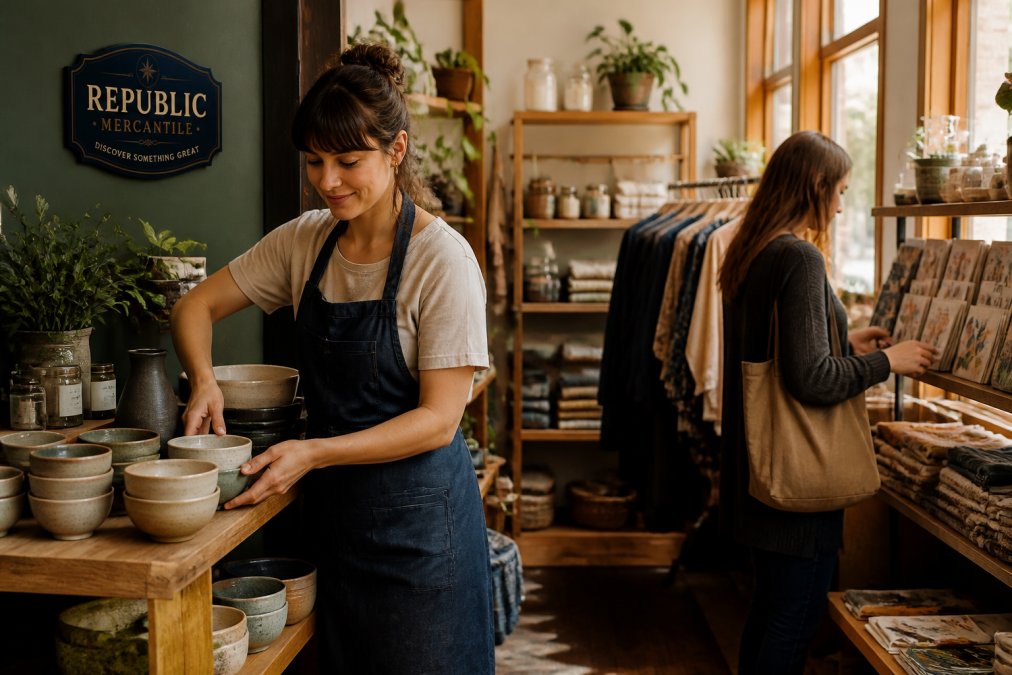
For shoppers, this matters because it removes the last excuse. You can support an independent retailer and still get the convenience you want. At Republic Mercantile, that model runs on a wide mix of categories, regularly refreshed inventory, and fast shipping, so a single order can cover various items without multiple checkouts.
Conclusion: Making the Choice That Aligns With Your Values and Budget
The case for independent retail isn't that it beats every alternative on every measure. It's that the trade-offs now favor local shops more often than most shoppers assume. Money stays closer to home, service comes from people who know the stock, and the environmental and community benefits compound over time.
If you want a single place to test that argument, Republic Mercantile offers a wide variety of product categories, new items added regularly, and fast shipping at prices built for budget-conscious households. Start with one order and see how it compares. SHOP NOW U.S. Small Business Administration guidance on supporting local businesses
Frequently Asked Questions
What are the economic benefits of shopping at independent retailers?
Independent retailers recirculate a larger share of revenue within their communities than national chains. When you buy from a local shop, more money stays in the area through local wages, supplier payments, and taxes that fund schools, roads, and emergency services. This creates an economic multiplier effect: each dollar spent locally generates additional economic activity. Independent retailers also tend to bank with local institutions and hire locally, strengthening the small business ecosystem.
How does shopping at independent stores affect product quality?
Independent retailers often stake their reputation on inventory curation rather than volume. They typically carry niche products and brands you won't find in big-box stores, and many prioritize supply chain transparency. Because they buy in smaller quantities, they can be selective about materials and construction. That said, quality varies by store. Ask about sourcing policies, return windows, and whether they stand behind what they sell before committing to a purchase.
Why is it important to support small businesses over large corporations?
Supporting small businesses preserves local entrepreneurship, keeps decision-making in your community, and maintains the neighborhood vitality that corporate retail often erases. Independent retailers also adapt faster to local needs because owners live where they work. They sponsor youth sports, donate to food drives, and create gathering spaces. When you buy from independent retailers, you're not just buying a product; you're voting for the kind of community you want to live in.
Do independent retailers offer better customer service?
Often, yes. Independent retailers provide personalized attention that large chains struggle to match. Staff at small shops frequently know their inventory in detail, can make personalized recommendations, and have authority to resolve issues on the spot. The trade-off is hours and convenience: many independents have limited operating hours and smaller return windows. If service matters more to you than 24/7 availability, independents usually win. If you need a return at 11 p.m., a large retailer may be your only option.
The challenge is simple: most people default to the biggest retailer out of habit, not because it's actually better. Republic Mercantile makes the alternative easy, with one-stop shopping across clothing, jewelry, home goods, and collectibles, fresh inventory added regularly, and fast shipping that keeps the convenience you're used to. Get started with Republic Mercantile and see how far your budget goes when you shop independent.