

Table of Contents
- How to Tell If Furniture Is High Quality Before You Click Buy
- Solid Wood vs Veneer Furniture: What the Specs Actually Mean
- Upholstery Fabric Durability Ratings Explained (Rub Count and Martindale)
- Measure Twice, Order Once: Getting the Fit Right
- Return Policies, Restocking Fees, and Warranty Coverage
- White Glove Delivery, Curbside Shipping, and Lead Times
- More Tips for Buying High Quality Furniture Online: Swatches, AR Tools, and Seasonal Sales
- Conclusion
- Frequently Asked Questions
Last Updated: September 20, 2026
How to Tell If Furniture Is High Quality Before You Click Buy
Shopping for furniture online removes the one sense that used to protect your wallet: touch. You cannot press a cushion or knock on a drawer front to hear whether it sounds solid or hollow, which is why so many people overpay for particle board dressed up in attractive photography. This guide walks through the specifications, ratings, and policies that separate genuine craftsmanship from marketing language.
Reading Product Specs Like a Buyer, Not a Browser
Product specs are where quality claims hold up or fall apart. A listing that says "wood" without naming the species is telling you something; one that says "kiln-dried hardwood frame" is telling you more.
Look for these specifics in any spec sheet:
- Named wood species such as oak, maple, walnut, or birch, rather than the generic word "wood"
- Frame material stated separately from the finish
- Weight capacity and overall product weight, since heavy pieces usually mean dense materials
- Assembly requirements spelled out in detail, not buried in fine print
- Country and method of construction when the seller provides it
Joinery, Frame Construction, and Kiln-Dried Hardwood
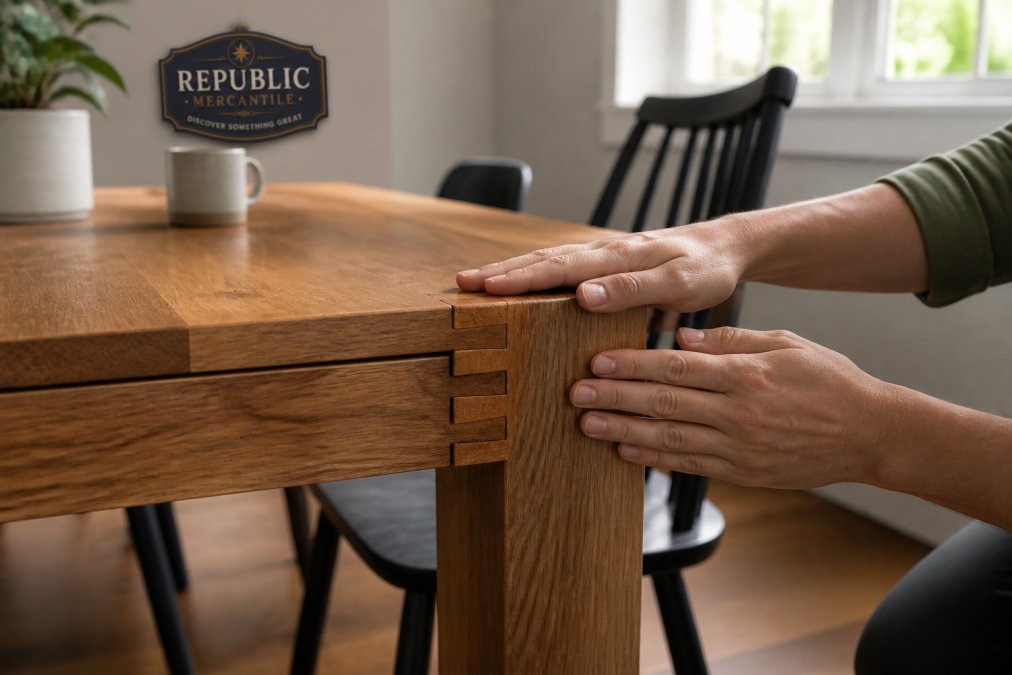
Joinery is the most reliable quality signal in furniture, and the one most online shoppers skip. Joinery refers to how pieces of wood are connected: dovetail joints interlock like puzzle pieces, while mortise and tenon joints seat a shaped tab into a matching cutout. Cheap furniture skips real joinery and relies on staples, glue, and screws driven straight into the wood, which loosen with normal use.
Solid Wood vs Veneer Furniture: What the Specs Actually Mean
Solid wood is cut from a single piece of timber throughout, while veneer is a thin layer of real wood bonded over a core of plywood or engineered board. Neither is automatically better. The right choice depends on where the piece will live and how it will be used.
| Material | Durability | Best For | Watch Out For |
|---|---|---|---|
| Kiln-dried solid hardwood | Highest | Dining tables, bed frames, investment pieces | Cost; seasonal movement |
| Plywood with wood veneer | High | Cabinets, shelving, large panels | Thin veneer that chips |
| MDF | Moderate | Painted surfaces, curved shapes | Cannot be repaired if stripped |
| Particle board | Lowest | Budget shelving, temporary use | Swells when wet; screws strip |
Particle Board, MDF, and Where They Make Sense
Particle board and MDF are not automatically disqualifying. A bookshelf that holds paperbacks does not need a mortise and tenon frame. A dorm room desk does not need kiln-dried oak.
Upholstery Fabric Durability Ratings Explained (Rub Count and Martindale)
Upholstery fabric durability is measured by how many times a machine can rub the fabric before it shows wear. That number is the rub count, and the test is the Martindale test. Higher numbers mean the fabric tolerates more friction before pilling, thinning, or tearing.
Rough benchmarks help you match fabric to room:
- Under 15,000 rubs: decorative use only, such as accent pillows
- 15,000 to 25,000 rubs: light use, such as a formal living room
- 25,000 to 30,000 rubs: everyday family use
- 30,000 rubs and above: heavy use, including pets and kids
Measure Twice, Order Once: Getting the Fit Right
Measurement accuracy prevents the most expensive mistake in online furniture shopping: a piece that does not fit through the door or looks wrong in the room. Measure the space, then the path to it.
Follow this sequence:
- Measure the room's usable wall length, not the full wall
- Measure every doorway, hallway turn, and stairwell the piece must pass through
- Check ceiling height in stairwells, since tall cabinets tip during turns
- Tape the footprint on the floor with painter's tape and live with it for a day
- Compare your tape outline against the listed dimensions, including any legs or handles that add depth
Return Policies, Restocking Fees, and Warranty Coverage
Return policy terms decide how much risk you carry, and they vary enormously between sellers. Read the policy before you add anything to a cart. On large furniture, the cost to send a piece back can approach or exceed the price of the piece itself, which means a "30-day return" can be functionally worthless if the terms are stacked against you.
Start with the definitions, because sellers use them loosely:
- Return policy, the seller's written terms for accepting a product back, including the window, condition requirements, and who pays shipping.
- Restocking fee, a percentage the seller keeps to cover processing a returned item, commonly applied to large furniture.
- Return shipping / freight, on a sofa or dresser, usually the single largest cost in the transaction, frequently deducted from your refund rather than billed separately.
- Warranty coverage, the manufacturer's promise to repair or replace a defect within a set period. It is separate from the return policy and usually does not cover buyer's remorse, normal wear, or damage you caused.
The Real Cost of Returning Furniture
Run the numbers before you buy:
- Original outbound shipping is rarely refunded. If the seller charged for delivery, assume that money is gone.
- Return freight is deducted from your refund. For a large item, this is often the biggest single line.
- Restocking fee is applied to the item price, not to the shipping.
- Assembly clause, many sellers void the return if the item was assembled. If you built it, you may own it.
Add those four numbers and compare them to the item price. If the total exceeds roughly a third of what you paid, the "return policy" is mostly a marketing feature, a reason to be more certain before you click buy.
What to Verify in Writing
Before checkout, confirm each of these in the seller's published policy or in a written reply from support:
- The return window, and whether it is counted from the order date or the delivery date. On custom or backordered furniture, the difference can be weeks.
- Whether return shipping is covered, capped, or deducted. "Free returns" on a large item usually means something narrower than it sounds.
- The restocking fee percentage and which categories it applies to. Some sellers waive it for defects and charge it for change-of-mind returns.
- Whether assembled furniture can be returned at all, and whether original packaging is required. Keep the boxes until you are sure.
- What the warranty covers, how long it runs, and whether it is pro-rated. A pro-rated warranty pays less each year, so a "10-year warranty" may cover very little by year eight.
- Whether the warranty is transferable if you sell the piece, and whether it requires registration within a set window.
Manufacturer Warranty vs. Seller Return Policy
These are two different promises, and confusing them is expensive. The seller's return policy governs whether you can send the item back and on what terms. The manufacturer's warranty governs whether a defect gets repaired or replaced after the return window closes.
White Glove Delivery, Curbside Shipping, and Lead Times
Delivery method changes both your total cost and your workload. Curbside shipping drops the box at the edge of your property. Threshold delivery brings it just inside the first door or garage. Freight to door delivers to your door or garage without assembly. White glove delivery brings the piece inside, assembles it, places it, and hauls away the packaging.
| Delivery Type | What's Included | Best For | Trade-off |
|---|---|---|---|
| Curbside | Drop-off at property edge | Small items, confident assemblers | You move and assemble it |
| Threshold | Placed just inside first door or garage | Medium pieces, ground-floor homes | You move it the rest of the way |
| Freight to door | Delivered to door or garage | Medium pieces, ground-floor homes | No assembly or placement |
| White glove | Inside placement, assembly, packaging removal | Large or heavy pieces, stairs, tight turns | Highest cost; scheduling constraints |
How to Vet a White-Glove Provider Before You Book
White glove is a service, not a product feature, and quality varies far more than price suggests. Before you commit:
- Confirm what "white glove" includes at that specific seller. Some providers place and assemble but do not remove packaging, or remove packaging but will not climb stairs. Get the scope in writing.
- Ask about stairs and tight turns. Many providers charge extra for upper floors or narrow stairwells, and some will not attempt a turn they judge too tight. Measure your stairwell and doorway clearances and share them with the seller before delivery day.
- Ask who actually performs the delivery. It is often a third-party freight carrier, not the retailer. Your recourse on damage runs through the retailer, but the crew that caused it works for someone else.
- Confirm the scheduling window and rescheduling policy. Missed-delivery fees are common and usually charged to you, not the carrier.
- Ask whether the crew will move existing furniture to make room. Many will not, and you do not want to discover that with a sofa halfway through the door.
What to Do on Delivery Day
Treat delivery day like an inspection, because your leverage disappears once the crew leaves and you sign.
- Clear the path and the destination before the crew arrives. Move fragile items, roll up rugs, and protect floors.
- Inspect the packaging before signing. Note any crushed corners, punctures, or water damage on the delivery receipt. If the box is damaged, open it before signing if the crew allows.
- Inspect the piece itself, not just the box. Check seams, corners, drawer alignment, and the frame for cracks. Photograph anything that looks wrong.
- Test the function. Open and close every drawer and door, sit on the cushions, and check that hardware is tight.
- Write exceptions on the delivery receipt. "Signed as received" without notes is the fastest way to lose a damage claim. Write "damaged, corner cracked" and photograph it before the crew leaves.
- Keep the packaging until you are certain you are keeping the piece. Many return policies require original packaging, and replacement boxes are expensive or unavailable.
Lead Times, Backorders, and Custom Orders
Lead times matter as much as delivery type and are the most common source of frustration in online furniture buying.
- In-stock items ship quickly but can sell out between the time you order and the time the warehouse picks it. Confirm the item is actually in stock, not "available to order."
- Custom upholstery is built after you order and commonly takes several weeks or longer. Ask whether the lead time is measured from the order date or from the date the item leaves the warehouse, the difference can be substantial.
- Backordered items may show an estimated date that slips. Ask whether the seller will notify you of delays and whether you can cancel without a fee if the date moves.
- Seasonal demand stretches lead times around major holiday weekends and end-of-season sales, exactly when discounts are deepest. If timing matters, pay for certainty rather than chasing the lowest price.
More Tips for Buying High Quality Furniture Online: Swatches, AR Tools, and Seasonal Sales
Fabric swatches and augmented reality tools close the gap online shopping creates. Request swatches before ordering upholstery, since screen color is never accurate and your home's lighting will change how a fabric reads. Most sellers ship swatches at low or no cost, and the wait is worth it on any piece you will live with for years.
Conclusion
The gap between a furniture purchase you love for a decade and one you regret by month three comes down to reading specs carefully, understanding materials, and knowing the return terms before you commit. Republic Mercantile stocks a rotating selection of home goods, clothing, and everyday essentials at prices built for real budgets, with new items added regularly and fast shipping.
Frequently Asked Questions
How can you tell if furniture is high quality when shopping online?
Look for specifics in the product description. A listing for high quality furniture will name the wood species (kiln-dried hardwood, solid oak, walnut), describe the joinery (dovetail, mortise and tenon), and give a rub count for upholstery. Vague terms like "wood finish" or "premium fabric" without numbers are a warning sign. Zoom into photos for grain continuity, tight seams, and even stain. If the listing is thin on detail, that usually reflects what you will unbox.
What rub count should I look for in upholstery fabric durability ratings?
Rub count measures how many times a fabric can be rubbed before showing wear, tested with the Martindale method. For everyday sofas and family seating, look for 15,000 to 25,000 double rubs. High-traffic pieces and homes with pets or kids do better at 30,000 or more. Under 10,000 double rubs suits decorative chairs and accent pieces only. The number should be listed in the specs; if it is missing, ask customer support before you buy.
Is solid wood always better than veneer furniture?
Not always. Solid wood is stronger at joints and can be sanded and refinished for decades, which is why it costs more. Veneer over a stable core like plywood or MDF resists warping and lets you get book-matched grain patterns at a lower price. The problem is thin veneer over particle board, which swells when wet and cannot be repaired. Check the core material, not just the surface. A quality veneer piece can outlast a cheap piece labeled solid wood.
How do I verify return policies for online furniture purchases?
Read the return page before checkout, not after. Confirm three things: the return window, who pays return freight, and whether a restocking fee applies. Furniture returns often cost $100 or more in freight, so a generous window means little if you cover shipping both ways. Also check whether the item must be in original packaging and whether assembled pieces are excluded. Screenshot the policy at purchase time in case terms change.