

Table of Contents
- Why Household Essentials Drain Your Budget
- How to Budget for Household Items That Actually Sticks
-
Bulk Buying Tips for Families: What to Stock Up On
- The 20% Rule: The Math That Prevents Overbuying
- The Storage Cost Test: Square Footage vs. Savings
- Unit Pricing: The Real Comparison, Not the Shelf Label
- The Consumption-Rate Calculator: Match Purchase to Usage
- What to Skip in Bulk: The Hidden Cost of "Deals"
- The Inventory Connection: Bulk Only Works With Visibility
- How to Use Coupons for Household Essentials Without the Clutter
- Cut Energy and Utility Bills with Small Changes
- Build an Inventory System to Stop Overbuying
- Best Online Home Goods Retailers for Rotating Deals
- The Psychology of Spending: Impulse Control at the Store
- Frequently Asked Questions
Last Updated: September 6, 2026
Household essentials quietly consume a larger share of monthly income than most families realize, yet few shoppers have a system for keeping those costs in check. This guide breaks down practical, measurable ways to cut those expenses without sacrificing quality.
Household essentials are the everyday consumables a home needs to function: cleaning products, personal care items, kitchen staples, and basic tools. These purchases happen frequently and feel too small to warrant planning, which is exactly how overspending creeps in.

Why Household Essentials Drain Your Budget
The biggest mistake with household essentials is treating them as unplanned, small-ticket purchases. Unlike a mortgage or car payment, these costs are variable and easy to overlook, yet they recur every single week.
Fixed expenses like rent and insurance get budgeted automatically, but discretionary spending on household goods often escapes scrutiny. Small, frequent purchases add up faster than occasional big ones because they never trigger a financial review.
How to Budget for Household Items That Actually Sticks
A household budget for essentials works when it accounts for real consumption patterns, not aspirational goals. Start by listing every consumable your home uses, then assign a monthly dollar figure based on actual usage rather than guessing.
Separate household essentials from food in your budget, since they follow different consumption cycles. Paper products and cleaning supplies often last longer than food, so their cost per use matters more than their shelf price.
Track Spending Habits for One Month First
Before you can cut costs, you need a baseline. For 30 days, save every receipt for household purchases and sort them into categories: cleaning, personal care, paper products, and tools.
One month of tracking reveals your family's true consumption rate, which tells you exactly how much to buy during sales without overstocking. From there, you can set a realistic monthly cap that still covers your needs.
Bulk Buying Tips for Families: What to Stock Up On
Bulk buying is the single fastest way to cut per-unit costs, but only when done with discipline. The goal is to stock up on items your family genuinely uses at a steady rate, not to fill a closet with bargains that expire or go stale.
Bulk buying tips for families start with knowing your consumption rate, which you calculated during your tracking month. If you use one bottle of dish soap every six weeks, buying six bottles at once is smart; buying twelve is hoarding.
The 20% Rule: The Math That Prevents Overbuying
Only buy in bulk when the unit price drops significantly below your regular shelf price, and only for items you will use within a reasonable timeframe. This prevents paying a mediocre per-unit price just because the package is large, and stockpiling items that go stale before you finish them.
Keep a running list of the regular unit price for your top 10 household essentials. When a warehouse club or online retailer runs a promotion, compare the sale unit price against your baseline.
The Storage Cost Test: Square Footage vs. Savings
A bulk purchase only makes sense if you have a designated place to store it that does not create new problems. Before you buy a 24-pack of paper towels, ask whether you have a shelf or cabinet that can hold them without blocking access to other items.
A practical test used by professional organizers: if the bulk item cannot be stored in its own dedicated zone without stacking on top of other items, skip it. A cluttered pantry leads to duplicate purchases, the exact opposite of what bulk buying is supposed to achieve.
Unit Pricing: The Real Comparison, Not the Shelf Label
Unit pricing is the practice of comparing cost per ounce, per sheet, or per load rather than the total shelf price. The unit price label on store shelves lets you compare a small bottle against a bulk pack to see which genuinely costs less.
A common mistake is assuming the jumbo size is always the best deal, when store brands or different formulations often beat it per unit. Compare unit prices across brands and sizes, and factor in whether you have space to store the larger option.
The Consumption-Rate Calculator: Match Purchase to Usage
Here is a concrete method to determine your true bulk-buying ceiling. Take the item's shelf life and divide it by your weekly usage rate. For example, a 100-ounce bottle of laundry detergent that lasts roughly 40 loads, with your family running 6 loads per week, will be gone in about 6.5 weeks. Buying three bottles at once covers roughly 20 weeks, a reasonable stockpile.
For cleaning supplies and personal care items, the degradation timeline matters. Most liquid detergents and soaps maintain full efficacy for 12 to 18 months when stored in a cool, dry place. Paper products and trash bags have essentially indefinite shelf lives, making them the safest bulk purchases.
What to Skip in Bulk: The Hidden Cost of "Deals"
Some items should never be bought in bulk, regardless of the per-unit price. Perishable cleaning products with active enzymes lose potency over time. Personal care items with a scent you might tire of are risky stockpiles. Any item requiring special storage conditions is a poor bulk candidate unless you have a dedicated climate-controlled space.
A final caution: warehouse club memberships are not automatically worth the annual fee. If your total annual savings from bulk purchases at a club does not exceed the membership cost, you are losing money.
The Inventory Connection: Bulk Only Works With Visibility
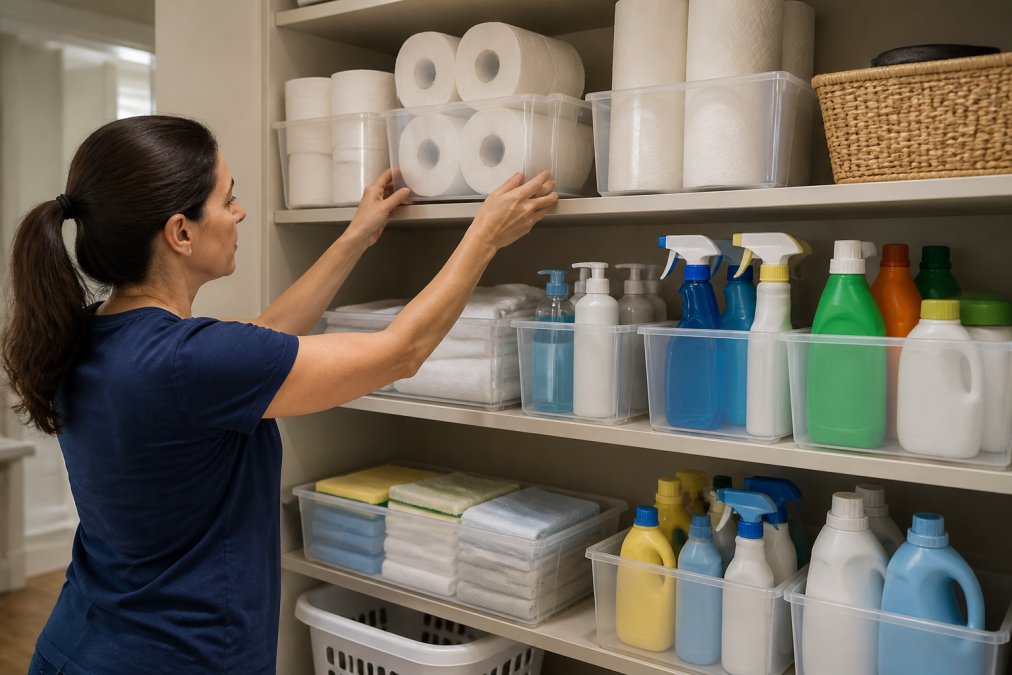
Bulk buying and inventory management are two sides of the same coin. A stockpile you cannot see is a stockpile you will rebuy. When you bring home a bulk purchase, immediately integrate it into your inventory system, whether that is a whiteboard list, a spreadsheet, or a clear storage bin with a label.
How to Use Coupons for Household Essentials Without the Clutter
Couponing for household essentials works best when it is digital and targeted, not the extreme clipping of decades past. The modern approach relies on store apps, manufacturer websites, and cash-back platforms that apply discounts automatically at checkout.
How to use coupons for household essentials effectively comes down to stacking: combining a store sale with a digital manufacturer coupon and a cash-back offer. Set a rule to only use coupons for items already on your shopping list, which prevents the trap of buying something just because it is discounted.
Stack Store Sales with Digital Coupons
The most powerful savings come from layering promotions. Weekly store circulars often pair with digital coupons in the retailer's app, and cash-back apps add another layer on top. When a sale price, a coupon, and a cash-back offer align, the final cost can drop well below the regular shelf price.
Price matching is another tactic worth using, since many retailers will honor a competitor's advertised price on identical items. Keep your shopping list organized by store so you know which retailer offers the best stacked deal for each product.
Cut Energy and Utility Bills with Small Changes
Energy efficiency is a form of saving on household essentials that most guides overlook, yet utility bills are a fixed monthly cost with real reduction potential. Small behavioral changes like running full dishwasher loads, washing clothes in cold water, and air-drying items can lower consumption noticeably.
Water usage matters too, since most utilities charge for both supply and heating. Fixing a dripping faucet, taking shorter showers, and running irrigation only when needed all reduce the bill without affecting comfort.
The 10% Rule: A Target That Drives Action
Most households can reduce their combined electricity, gas, and water bills by at least 10% within 90 days using behavioral changes alone, without any capital investment. To hit that target, you need to know where your energy dollars actually go.
Start by pulling your last 12 months of utility bills and calculating your average monthly spend. Heating and cooling typically account for roughly half of a typical home's energy consumption, water heating for about 18%, and appliances and lighting for the remainder.
The Thermostat Math: Setback Savings That Add Up
A programmable or smart thermostat is the single highest-ROI change for most households. Setting your thermostat back 7-10 degrees Fahrenheit for 8 hours per day can save on heating and cooling costs annually.
The mechanism is simple: during work hours and overnight, your home does not need to be at daytime comfort temperature. Set the thermostat to 68°F in winter when you are home and awake, then drop it to 60°F at night or when the house is empty. In summer, set it to 78°F when home and raise it to 85°F when away.
The Phantom Load Hunt: Find the Silent Drainers
Electronics and appliances in standby mode, often called "phantom loads" or "vampire power", can account for 5-10% of a typical home's electricity use. The culprits are devices that draw power even when "off": cable boxes, gaming consoles, phone chargers left plugged in, microwaves with digital clocks, and smart home hubs.
The fix is not to unplug everything, that is impractical. Instead, use smart power strips that cut power to devices when the primary device is off. A household that eliminates continuous phantom load can save on electricity annually.
Water Heating: The Second-Biggest Target
After HVAC, water heating is typically the largest energy expense. The cheapest fix is behavioral: wash clothes in cold water, which most modern detergents handle fine, and take shorter showers.
A low-flow showerhead is a high-ROI upgrade. Standard showerheads flow at 2.5 gallons per minute; low-flow models use 1.5-2.0 gallons per minute. For a family of four taking one shower per day, that reduction saves gallons of heated water per year. Most utility companies offer rebates or free low-flow showerheads through their efficiency programs.
The Free Audit: Your Utility Company's Hidden Resource
Many utility providers offer home energy audits. A professional auditor can find air leaks, inspect insulation levels, and check your HVAC system's efficiency.
Many utilities also offer instant rebates on LED bulbs, smart thermostats, and efficient showerheads. Some states have weatherization assistance programs that provide insulation and air sealing for qualifying households.
The Behavioral Stack: Combine Small Changes for Compound Savings
No single change will transform your utility bill, but stacking several behavioral adjustments creates compound savings. Run full dishwasher loads instead of partial ones, air-dry clothes on a rack for at least half of your laundry, and use the microwave or toaster oven instead of the full oven for small meals.
Track your usage month over month using your utility bill's usage chart, which most providers include online. If your bill does not drop after implementing these changes, re-audit your home for air leaks around windows and doors, weatherstripping is a low-cost fix that pays for itself within one heating season.
Build an Inventory System to Stop Overbuying
An inventory system is the missing piece for most households, and it directly prevents the overbuying that wrecks budgets. The concept is simple: know what you have, where it is stored, and when it runs low.
Start by designating a storage zone for each category of essentials and grouping like items together. When you open a new container of dish soap or a fresh roll of paper towels, add it to your list, and when you use the last one, that is your restock trigger.
An under-sink organizer transforms cluttered cabinets into structured storage by maximizing vertical space, which makes inventory visible at a glance. Republic Mercantile offers a 2 Pack Under Sink Organizer with Drawer that consolidates cleaning supplies and toiletries into a dual-level layout with a smooth sliding drawer. When you can see your stock, you stop buying duplicates and start using what you own.

Best Online Home Goods Retailers for Rotating Deals
Online shopping for household essentials opens access to rotating deals, flash sales, and bulk pricing that physical stores rarely match. The best online home goods retailers combine wide product selection with regular inventory updates, so loyal customers catch new markdowns each week.
Republic Mercantile offers a diverse range of everyday essentials, from clothing and jewelry to home goods and collectibles, with new items added regularly. Fast shipping and cost-effective pricing make it a practical one-stop option for families consolidating their household purchases.
The Psychology of Spending: Impulse Control at the Store
Understanding why you overspend is as important as knowing how to save, because behavior drives most budget failures. Retailers design store layouts, online pop-ups, and "limited time" messaging to trigger impulse purchases, which are rarely planned and rarely needed.
Impulse control improves with a simple rule: never buy a household essential without checking your inventory list first. If you are in a physical store, that means pausing before the checkout display; online, it means leaving items in the cart for 24 hours before purchasing.
Sustainable frugality, rather than deprivation, is the mindset that makes these habits stick. Buying quality tools and organizers that last, like Republic Mercantile's 10 Piece Screwdriver Set for household repairs, prevents repeated spending on cheap replacements. When saving becomes a system instead of a series of willpower battles, the results compound month after month.
Cutting household costs is not about extreme sacrifice; it is about building simple systems that prevent waste and capture discounts. The strategies covered here, from inventory tracking to strategic bulk buying, can work together to lower your monthly spending without changing your lifestyle. Get started with Republic Mercantile and turn your household budget into a system that works.
Frequently Asked Questions
Is $100 a week too much for groceries?
For a single person, $100 a week is on the higher side. For a family of four, $100 a week is quite tight and requires diligent meal planning. Focus on your household budget and track your monthly spending to see what fits your income and financial goals.
How do I create a budget for household essentials?
Start by tracking every purchase in this category for one month. Separate fixed expenses like rent from variable costs like groceries. Then, set a dollar amount based on your past spending and income. Allocate cash or a dedicated account for this budget. Review it weekly and adjust as needed to build sustainable spending habits.
Are generic brands always cheaper than name brands for household goods?
Often, yes, but not always. Generic brands usually cost less than name brands for items like paper towels, cleaning supplies, and basic pantry staples. However, check the unit pricing on the shelf tag. Occasionally, a name brand on a deep discount or with a digital coupon will be cheaper per ounce than the store brand.
What are the best times of year to buy household staples in bulk?
Seasonal sales offer the deepest discounts. Stock up on cleaning supplies in spring during 'spring cleaning' promos. Look for paper goods and non-perishables around major holidays like Memorial Day, July 4th, and Labor Day. Back-to-school season in August is ideal for organizational items like storage bins and under sink organizers.
How can I reduce waste to save money on household supplies?
Use a 'first in, first out' rule with your inventory system. Store new items behind older ones so you use what you have before it expires. Buy concentrated cleaning products and dilute them as directed. Switch to reusable microfiber cloths instead of paper towels for most spills to cut down on recurring costs.
How do I track my spending on household essentials?
Use a simple spreadsheet or a budgeting app on your phone. Record every purchase immediately after you make it, or save receipts and log them weekly. Categorize items as 'groceries' or 'cleaning supplies' to see where your money goes. Reviewing this data monthly reveals your spending habits and highlights areas for improvement.