

Last Updated: November 4, 2026
Quick Summary
To insure rare collectibles without overpaying, appraise only the high-value pieces and inventory the rest, then choose a scheduled personal property endorsement for small, stable collections or a standalone policy for large or growing ones. Push for agreed value coverage, since actual cash value pays replacement cost minus depreciation.
- Standard homeowners policies cap collectibles with a sub-limit, a narrow peril list, and a deductible that eats small claims.
- Reappraise bullion annually and graded cards, comics, and coins every two to three years.
- An appraisal prepared for estate or tax purposes is not automatically accepted for insurance scheduling.
- Photograph the storage setup itself, including the safe and any hygrometer reading, to support a claim.
- Confirm in writing whether your policy covers digital collectibles and NFTs, because many standard policies do not.
Table of Contents
- Why Standard Homeowners Coverage Falls Short for Rare Collectibles
- How to Appraise Collectibles for Insurance
- Scheduled Personal Property Endorsement vs. a Standalone Policy
- Agreed Value vs Actual Cash Value Insurance: Which Pays More
- Building an Itemized Inventory With Proof of Ownership
- Storage, Grading, and Digital Assets: What Adjusters Look For
- Choosing Coverage for Your Collection at Republic Mercantile
- Frequently Asked Questions
Why Standard Homeowners Coverage Falls Short for Rare Collectibles
Most collectors assume their homeowner's policy covers everything under the roof, but to insure rare collectibles you need more than that. It usually doesn't. To insure rare collectible items, start by understanding why your existing coverage leaves you exposed.
Standard homeowners policies treat collectibles as ordinary personal property, and three limits work against you: a sub-limit, a narrow list of covered perils, and a deductible that eats small claims.
Sub-limits, perils, and the deductible trap
A sub-limit is a cap buried inside your policy that limits how much you can recover for certain categories of property.
Perils matter too. A standard policy may cover fire or theft but exclude accidental damage, breakage, or gradual deterioration.
Then there is the deductible. If your deductible is high and your item is modest, filing a claim can cost more than the loss, and a small claim can affect future premiums.
The National Association of Insurance Commissioners consumer guide to homeowners insurance explains how sub-limits and deductibles interact. If your collection holds long-term value, it helps to understand the long term investment potential of rare collectibles before you decide how much protection is worth paying for.
How to Appraise Collectibles for Insurance
An appraisal is a written valuation of your item prepared by a qualified professional. Insurers use it to set coverage limits and verify value at claim time. You often need one for high-value pieces.
How to appraise collectibles for insurance comes down to three inputs: condition, provenance, and current market value. A good appraiser documents all three with photographs and comparables.
The three appraisal methods appraisers actually use
Most written appraisals rely on one or more of these approaches, and the method matters because it changes the number the insurer sees:
- Comparable sales (market approach): The appraiser finds recent arm's-length sales of the same item in similar condition. This is the standard method for graded cards, key-date coins, and other items with an active resale market.
- Replacement cost approach: The appraiser estimates what it would cost to buy an equivalent item today from a dealer, including buyer's premiums and shipping. This figure supports agreed value coverage.
- Income approach: Rarely used for collectibles, but it appears for items held as an investment, such as certain bullion or high-end art. Treat any income-based figure with skepticism unless the appraiser explains the assumptions.
A single appraisal often blends methods, listing a market value and a separate replacement value. Read both lines. If the policy is written on agreed value, the replacement figure should anchor the schedule.
Who is qualified to appraise, and what credentials to look for
Appraisal credentials are not one-size-fits-all. Match the credential to the category:
- Coins and currency: Look for membership in the American Numismatic Association or accreditation through the Appraisers Association of America. A dealer who buys and sells the same material is not automatically a qualified appraiser.
- Stamps: The American Philatelic Society maintains an expertizing service and appraiser referrals; philatelic appraisals should account for centering, gum condition, and cancellation quality.
- Fine art and antiques: The Appraisers Association of America and the American Society of Appraisers both credential personal property appraisers, with specialty designations by category.
Ask for a sample appraisal before you commission one. A usable report states the intended use (insurance scheduling), the valuation method, the effective date, and the appraiser's signature and credentials.
When a certified appraisal is worth the fee
Consider a certified appraisal when an item is high value, rare, or hard to price.
- Worth the fee: graded cards, certified gemstones, key-date coins, signed items, anything you would struggle to replace.
- Skip it: common modern cards, low-value comics, everyday jewelry.
A common mistake is commissioning one appraisal for an entire collection when only a few pieces carry real value. Appraise the high-value items and inventory the rest.
How often to reappraise, and why the date matters
An appraisal is a snapshot, and insurers know it. Collectible markets move, sometimes sharply, and a stale appraisal can leave you underinsured or overpaying. A practical cadence:
- Annually: Bullion, metals, and anything whose value tracks a spot price.
- Every two to three years: Graded cards, comics, and coins with active markets. Reappraise sooner after a well-publicized price surge.
- On any material change: After restoration, regrading, or a significant purchase, update the schedule rather than waiting for the cycle.
Watch out: an appraisal prepared for estate or tax purposes is not automatically accepted for insurance scheduling, because the intended use and valuation basis differ. Tell the appraiser the report is for insurance.
If you are weighing whether a specific category justifies the expense, whether collecting vintage comic books is worth it offers useful context on value and effort.
Scheduled Personal Property Endorsement vs. a Standalone Policy
A scheduled personal property endorsement is an add-on to your existing homeowners policy that lists specific items and insures them individually.
The endorsement is simpler and often cheaper for a small, well-defined collection.
The standalone policy wins when your collection is large, growing, or valuable enough that a single homeowners claim would strain your coverage.
| Feature | Scheduled Endorsement | Standalone Policy |
|---|---|---|
| Best for | Small, fixed collections | Large or growing collections |
| Setup effort | Low, added to existing policy | Higher, separate application |
| Coverage limits | Moderate | Higher |
| Perils covered | Broader than base policy | Usually broadest |
| Deductible | Often reduced or removed | Varies by policy |
A practical rule: if you want to insure rare collectibles on a modest, stable budget, start with the endorsement.
Agreed Value vs Actual Cash Value Insurance: Which Pays More
Agreed value insurance pays a pre-set amount if a covered item is lost.
Under agreed value, you and the insurer settle on a value up front and that figure is the payout.
2002 USPS Night Friends American Bats 37¢ Stamps Full Sheet of 20 Mint Unused →
For rare items, push for agreed value. It removes the depreciation argument and makes the claims process predictable.
Ask for the valuation basis in writing before you sign.
Building an Itemized Inventory With Proof of Ownership
An itemized inventory is a written list of each collectible with its description, value, and proof you own it. Adjusters rely on it when a claim arrives.
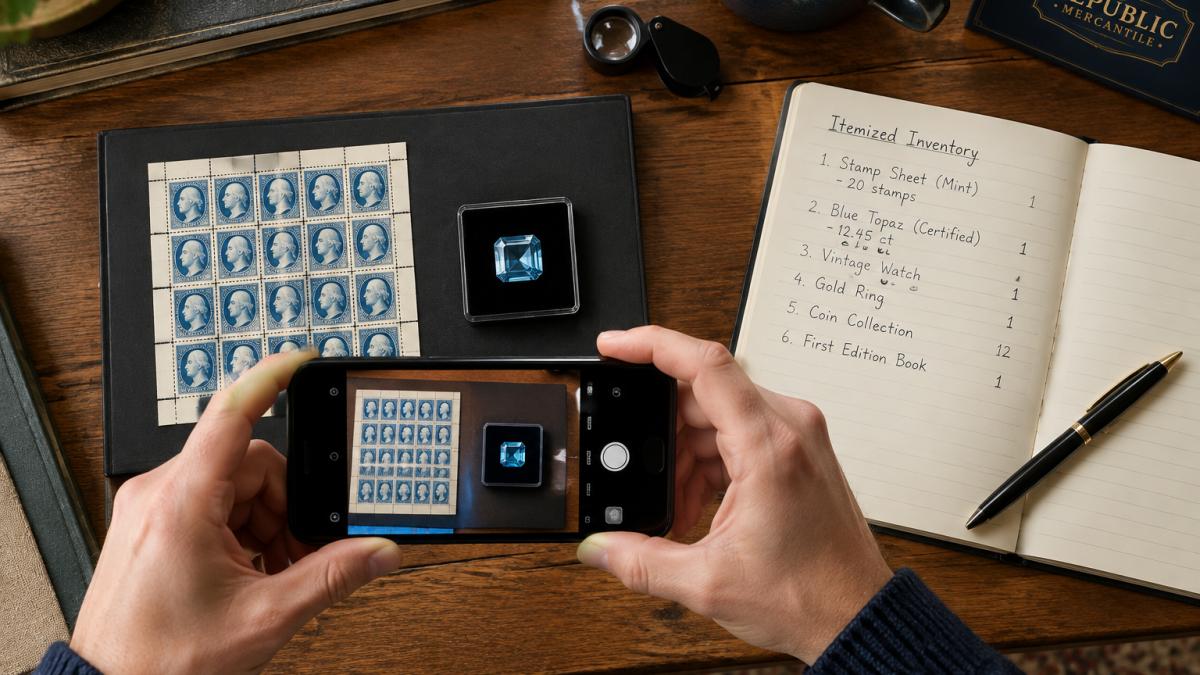
Build yours with these fields for every item:
- Item name and category
- Purchase date and price
- Certification or grading details
Keep a copy of the inventory in digital form and a printed copy. A documented piece like this certified 5.25 CT round cut purple alexandrite is the kind of item you would record in your inventory.

Watch out: a photo of the item alone is weak proof. Pair it with a receipt or certificate so the adjuster can tie the item to you.
Storage, Grading, and Digital Assets: What Adjusters Look For
Adjusters look for evidence that you protected the item and can prove its condition. Storage security, professional grading, and clear documentation all support a claim. Poor storage can reduce or void a payout.
The storage conditions insurers actually require
- Enclosures: Archival-grade, acid-free sleeves and boxes. PVC holders and ordinary plastic bags off-gas and can damage paper and cards over time.
- Security: A safe, locked cabinet, or monitored alarm. For high-value pieces, a bolted safe or a bank safe deposit box is the standard. Photograph the safe and keep the model and serial number in your inventory.
- Off-site storage: If you use a climate-controlled storage facility, keep the contract and note the unit number in your inventory.
Photograph the storage setup itself, not just the items. A dated photo of a humidity-controlled cabinet with a hygrometer reading supports a claim rather than inviting a dispute.
How professional grading changes the claim
Professional grading adds credibility. A certified, cased piece like this 1CT white moissanite round loose gemstone is exactly the kind of documented item that speeds up an adjuster's review.
A grade is a condition baseline recorded by a neutral party before the loss. Without it, the adjuster has only your description, and condition drives value for cards, comics, and coins.
Digital collectibles and NFTs: the coverage gap
Digital assets are the newest gap. If you hold digital collectibles, confirm in writing whether your policy covers them, because many standard policies do not. Ask specifically about digital asset and NFT coverage before you assume you are protected.
The mechanics differ from physical collectibles in ways that affect claims:
- What "loss" means: A stolen NFT is a wallet compromise, not a burglary. Standard policies are written around physical perils, so the trigger may not exist at all.
- Proof of ownership: Wallet addresses and blockchain records can serve as proof, but the insurer needs a documented chain tying the asset to you. Keep screenshots of the wallet, transaction hashes, and the marketplace record.
- Valuation: Digital collectibles can be volatile, and actual cash value calculations are unsettled. If coverage exists, agreed value is the only predictable basis.
A specialty policy or a rider written for digital assets is the realistic route. Do not assume a scheduled endorsement on a homeowners policy reaches them.
The tax question after a payout
Keep purchase records and appraisals together so you can establish basis if a settlement is questioned. Confirm the tax treatment of any payout with a tax professional.
A documentation checklist for the claim file
Keep one folder, digital and printed, containing:
- The itemized inventory with photos and receipts
- Current appraisal and the appraiser's credentials
- Grading certificates and holder photos
Watch out: a claim filed months after a loss, with no dated storage or condition evidence, is the most common way collectors lose arguments with adjusters. Build the file before you need it.
Choosing Coverage for Your Collection at Republic Mercantile
Coverage decisions start with knowing what you own. At Republic Mercantile, we stock a rotating mix of collectibles.
Here is how we would approach it:
- Low-value, high-volume pieces: skip the standalone policy and use a scheduled endorsement. A sealed Pokémon Scarlet & Violet poster collection fits this tier.
- Bullion and metals: confirm your policy handles market value, since metal prices move. A 1 oz .999 fine silver St. Gaudens round is an example of an item to list separately.
- Paper collectibles: store them in a controlled environment and photograph the storage. A mint sheet of 2002 USPS Night Friends bat stamps is an example of a paper collectible to document.
Learn more about Republic Mercantile and how we source the collectibles we sell. The Insurance Information Institute guide to personal property coverage is a useful reference as you compare options. For a deeper look at how grading affects value, the Professional Numismatists Guild resources on authentication explain why certification matters.


Frequently Asked Questions
Can collectibles be insured under a standard homeowners policy?
Usually only partially. Homeowners policies often cap theft or loss of collectibles at a sub-limit and may exclude breakage or gradual deterioration. High-value items like a certified 5.60 CT oval cut purple alexandrite need a scheduled personal property endorsement or a standalone collectibles policy. Read your policy's fine print and add a rider before a loss, not after.
What is the difference between agreed value and actual cash value for collectibles?
Agreed value pays a dollar amount fixed at underwriting, so you know the payout before a loss. Actual cash value pays replacement cost minus depreciation, which can leave you short on a rare item with no clear market comp. For scarce pieces, agreed value can be the safer choice because it removes the depreciation argument at claim time.
How much does collection insurance cost?
Premiums vary by value, category, storage, and deductible. Insurers underwrite based on appraisals, provenance, and risk mitigation like alarms and climate control. Ask your insurer for a quote and compare how deductible choices affect the premium.
What documentation is required to insure rare items?
Insurers commonly ask for a dated itemized list, purchase receipts, clear photographs, and certificates of authenticity; confirm requirements with your insurer. Keep digital copies in cloud storage and update the inventory annually. For graded cards or certified gemstones, include the grading or certification number so the insurer can verify the collectible grade and provenance.
The real challenge is not buying coverage. It is knowing what you own well enough to insure it correctly. Republic Mercantile makes that easier with a rotating inventory of documented collectibles, fast shipping, and prices that leave room in your budget for the coverage itself. Browse our collectibles, build your inventory, and protect what you love. Get started with Republic Mercantile and shop with confidence today.
