

Last Updated: November 4, 2026
Quick Summary
To store leather shoes without cracking, clean them first, then condition the leather so it stays flexible. Insert cedar shoe trees to hold the shape, and keep the shoes in a cool, dry spot in breathable dust bags, not plastic.
- Brush off dirt and dry the shoes at room temperature before storing them.
- Condition thin coats of leather conditioner, since leather loses oils that keep it flexible.
- Insert cedar shoe trees right after cleaning and conditioning to prevent creasing.
- Aim for a stable spot near 60°F to 70°F with 40% to 60% humidity, away from radiators and sunny windows.
- Wrap shoes in breathable dust bags, because plastic traps moisture that causes mildew.
Table of Contents
- Why Leather Shoes Crack in Storage
- Step 1: Clean Your Leather Shoes Before Storing Them
- Step 2: Condition the Leather Before It Goes Away
- Step 3: Use Cedar Shoe Trees to Hold Their Shape
- Step 4: Choose a Cool, Dry Storage Spot
- Step 5: Wrap and Protect With Dust Bags, Not Plastic
- How to Store Leather Boots Without Damaging the Shaft
- Preparing Leather Shoes for Long-Term Storage and Seasonal Rotation
- Frequently Asked Questions
Why Leather Shoes Crack in Storage
Leather is a natural material, and it dries out over time. When leather shoes sit unused in a closet, the oils that keep the hide soft slowly evaporate. This guide will help you protect your footwear, so you can learn how to store leather shoes without cracking them.
Cracking usually happens for three reasons. The leather loses its natural oils, the shoes get creased in the same spots for months, and moisture or heat dries the material out. Each of these problems is preventable with a little planning.
- Dry air pulls moisture out of the hide.
- Heat from vents, radiators and sunny windows speeds up drying.
- Folded or bent shoes set creases that eventually split.
- Trapped dirt grinds into the grain and weakens it.
Knowing the cause makes the fix easier. Clean the shoes, feed the leather, support the shape and keep them somewhere stable. Let's walk through each step.
Step 1: Clean Your Leather Shoes Before Storing Them
Never store dirty shoes. Dirt and salt left on leather can work into the grain during months in a closet. Wipe off dust with a soft cloth, then brush away loose grit with a horsehair brush.
A simple cleaning routine looks like this:
- Remove the laces and insoles.
- Brush off dry dirt with a horsehair brush.
- Wipe the surface with a damp cloth, using a small amount of mild leather cleaner.
- Let the shoes air dry at room temperature for several hours.
For tough stains, a dedicated leather cleaner works better than soap and water. You can find a professional window squeegee scrubber cleaning tool that handles the job on many surfaces. Use a damp microfiber cloth so you always have a clean surface to wipe with. A pack of microfiber cleaning cloths gives you plenty for every pair.


Watch out: Never soak leather or dry it with a hair dryer. Fast heat causes the hide to shrink and crack.
Step 2: Condition the Leather Before It Goes Away
Conditioning is the single step that most directly prevents cracking, because it replaces the oils and fats that evaporate out of the hide while shoes sit unused. Dry leather loses flexibility, and inflexible leather splits along the creases that form at the toe box and vamp. Conditioning restores some of that flexibility before the shoes go into storage.
Apply a thin layer of leather conditioner with a soft cloth in small circles, working it into the grain rather than piling it on. Let it soak in for about 20 minutes, then buff off the excess with a clean cloth. A little goes a long way; excess conditioner can leave a tacky film that attracts dust.
How you condition depends on the leather, and this is where most guides stay silent:
- Full-grain and top-grain leather: These absorb conditioner well and tolerate a standard cream or lotion conditioner. Condition once before long storage and again every few months if the shoes sit for a long stretch.
- Suede and nubuck: Do not use a standard cream conditioner, which mats the nap and darkens the surface. Use a suede-specific protector spray and a suede brush instead, and keep these shoes out of humid spots where the nap can stiffen.
- Patent and other finished leathers: The surface is sealed, so conditioner cannot penetrate. Wipe with a damp cloth, dry fully, and rely on shape support and a stable environment rather than oil-based products, which can cloud the finish.
- Exotic and oiled leathers: Follow the maker's instructions; some oiled leathers want a dedicated oil rather than a cream, and over-conditioning can darken them unevenly.
Check the care label or the maker's instructions before you buy a product, and test any new conditioner on a small hidden area first.
Watch out: over-conditioning is a real failure mode, a heavy layer that never absorbs can soften the leather too much and weaken the structure, so thin coats beat thick ones.
Conditioning needs vary by leather type, so here is how to approach each one.
| Leather type | Conditioning approach | Key caution |
|---|---|---|
| Full-grain and top-grain | Cream or lotion conditioner, once before long storage | Condition again every few months if storage is long |
| Suede and nubuck | Suede-specific protector spray and a suede brush | Standard cream mats the nap and darkens the surface |
| Patent and finished | Wipe with a damp cloth and dry fully | Oil-based products can cloud the finish |
| Exotic and oiled | Follow the maker's instructions | Over-conditioning can darken unevenly |
Step 3: Use Cedar Shoe Trees to Hold Their Shape
Shoe trees keep leather from creasing and help it hold its shape. Cedar is a common choice for shoe trees.
Insert shoe trees right after you clean and condition the shoes. If you don't own shoe trees, you can stuff the toes with paper.
Step 4: Choose a Cool, Dry Storage Spot
"Cool and dry" is the right instinct, but it is too vague to act on. Leather is happiest in a stable environment, and stability matters as much as the absolute numbers. Most practitioners aim for a storage area that stays between roughly 60°F and 70°F with relative humidity in the 40% to 60% band. Below about 40% humidity, the hide gives up moisture to the air and dries out faster. Above roughly 60%, mold and mildew become a real risk, especially on the linings and welts where air does not move.
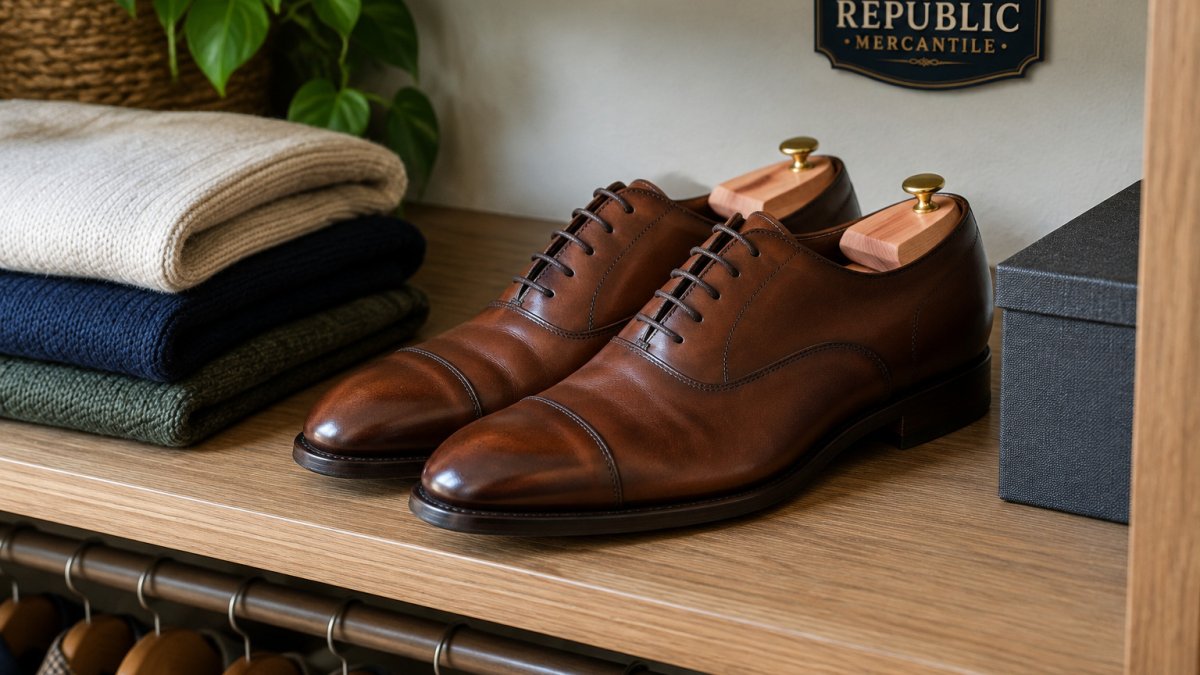
Pick a spot that stays stable. An interior closet wall, a bedroom closet, or a mid-height shelf away from exterior doors all work. Avoid attics, basements, and garages, which swing the most in temperature and humidity. Keep shoes away from radiators, heating vents, and sunny windows; direct sun fades leather and radiant heat dries it quickly. Leave a little space between pairs so air can move around them, a closet packed tight traps humid air against the leather.
Climate changes the protocol, and this is where generic guides fall short:
- High-humidity climates: Prioritize airflow over enclosure. Prioritize airflow over enclosure during the wettest months. Check shoes monthly for musty smells or white bloom on the surface, and air them out on a dry day.
- Arid climates: The opposite problem. Low humidity pulls oils out of the hide, so condition a little more often and consider keeping shoes in a closed closet rather than an open rack near a vent.
- Four-season swings: The transition months are the danger zone. When indoor heating kicks on in fall, humidity drops fast; that is the week to re-check conditioner and hygrometer readings rather than waiting for spring.
Watch out: a spot that feels dry to the touch can still be too humid for leather, trust the hygrometer reading, not your hand.
Step 5: Wrap and Protect With Dust Bags, Not Plastic
Protect your shoes from dust with breathable dust bags. Plastic bags look like a good idea, but they trap moisture against the leather. That trapped moisture can lead to mildew and sticky residue.
Breathable storage boxes work well for longer storage.
Use dust bags for individual pairs and boxes for groups. A stackable hat storage box with sturdy sides can keep a set of shoes protected on a shelf.

How to Store Leather Boots Without Damaging the Shaft
Leather boots need extra care because the tall shaft can crease or slump. Without that support, the shaft can fold down and set permanent creases.
Stand boots upright when possible. Never fold the shaft over itself.
Conditioning matters even more for boots, since the shaft flexes every time you walk. Apply conditioner to the shaft as well as the vamp and heel.
Store boots in a cool, dry spot with good airflow.
Preparing Leather Shoes for Long-Term Storage and Seasonal Rotation
Shoes stored for months need a longer routine than shoes you rotate weekly. Before a long break, clean and condition each pair, insert shoe trees and wrap them in breathable dust bags.
For seasonal rotation, check your shoes every few months. Look for dry spots, small creases and smells. Wipe them down and add conditioner if you spot early signs of drying.
Short-term storage, such as a few weeks between wears, needs less effort. A quick brush, shoe trees and a dry closet are usually enough.
Long-term storage works best when you plan ahead. Set a reminder to check your shoes twice a year. Small, regular care keeps leather soft and extends its life for years.
For more tips on keeping your footwear in good condition, see How to Repair Worn Out Shoe Soles at Home before you put your shoes away for the season.
Frequently Asked Questions
How do I keep my leather shoes from cracking?
Clean off dirt and salt, let the shoes dry at room temperature, then apply a thin layer of leather conditioner before storing them. Keep them in a cool, dry closet with stable humidity and avoid direct sunlight and radiators. Conditioning every few months during long storage keeps the leather supple, and full-grain leather generally holds up better than corrected or bonded leather.
Is it better to store shoes in cardboard or plastic boxes?
Breathable storage is better. Plastic traps moisture against the leather, which can lead to mildew and dehydration once the air inside is trapped and cycled with temperature changes. Breathable storage containers work well because they allow airflow while blocking dust and light. If you use a clear box for visibility, leave the lid slightly open.
Should I use cedar shoe trees when storing leather shoes?
Yes. Cedar shoe trees absorb moisture from the leather's interior, help the shoe keep its shape, and prevent creasing at the vamp. Cedar also releases a light scent that deters moths. Insert shoe trees right after you take the shoes off, and leave them in during storage so the leather doesn't collapse and crack at the flex points.
How often should I condition leather shoes in storage?
For shoes that stay in storage for several months, condition them every three to six months with a quality leather conditioner, applying a thin, even coat and letting it absorb before buffing. Check the leather before each season: if it looks dull or feels stiff, condition it sooner. Always test a conditioner on a hidden area first, since some products can darken lighter leathers.
Ready to build a storage kit for your shoes? Shop everyday essentials and home storage picks at Republic Mercantile, with new items added regularly and fast shipping to get your gear to you quickly.
