

Table of Contents
- Why Non-Toxic Cleaning Products Matter for Your Family
- Best Non-Toxic Cleaning Products to Stock Your Home
- Safe Cleaning Products for Babies and Pets
- Non-Toxic All-Purpose Cleaner Options and How to Use Them
- Refillable Cleaning Products and Budget-Friendly Alternatives
- Common Mistakes to Avoid When Switching to Non-Toxic Cleaners
- Frequently Asked Questions
Last Updated: October 13, 2026
Why Non-Toxic Cleaning Products Matter for Your Family
Choosing non-toxic home cleaning products for families matters because you're shaping the environment where your family breathes, plays, and sleeps.
Traditional cleaning products often contain synthetic chemicals that irritate skin, trigger respiratory issues, and accumulate at home. Babies and young children are especially vulnerable because their bodies are still developing and they spend more time on floors and touching surfaces, while pets are affected by harsh residues left on tiles, wood, and countertops.
You don't need toxic chemicals to get a clean home: plant-based solutions work on everyday messes and fit any budget.
Best Non-Toxic Cleaning Products to Stock Your Home
Building a non-toxic cleaning cabinet doesn't mean buying dozens of specialty products, focus on versatile multi-purpose cleaners plus a few targeted solutions.
Plant-Based Ingredients vs. Synthetic Chemicals
Plant-based cleaning products rely on citric acid, vinegar, essential oils, and plant-derived surfactants rather than petroleum, breaking down dirt and grease without harsh residues.
Synthetic chemicals are engineered to be powerful, but come with trade-offs: strong fumes, skin sensitivity, and buildup on surfaces.
The key difference: plant-based cleaners break down faster in your home and the environment, while synthetic chemicals linger on surfaces and in the air.
Reading Labels: What to Look For and What to Avoid
When you're shopping for non-toxic home cleaning products for families, the label tells the story. Here's what matters:
Look for:
- Ingredient transparency: The product lists every ingredient, not just "proprietary blend"
- Plant-derived surfactants: Coconut, corn, or other plant-based cleaning agents
- Fragrance sourcing: Essential oils or natural fragrance, not synthetic perfumes
- Certifications: Look for third-party seals like EPA Safer Choice, which verifies safer chemical formulations
Avoid:
- Artificial fragrances and dyes: These can trigger headaches and respiratory sensitivity
- Phosphates and chlorine: Common in older formulations, these are harsh on skin and harmful to aquatic life
- Preservatives like parabens and formaldehyde releasers: These accumulate in your body over time
- Vague language: If a label says "natural" but doesn't list ingredients, move on
A practical tip: if you can't pronounce an ingredient, look it up. Many safe ingredients have complex names. But if a product refuses to list ingredients at all, that's a red flag.
Safe Cleaning Products for Babies and Pets
Babies and pets experience your home at floor level, they touch surfaces, put hands in their mouths, and breathe in fumes. This is where non-toxic home cleaning products for families become non-negotiable, but "non-toxic" on a label isn't the same as "safe in every room, at every age, on every surface."
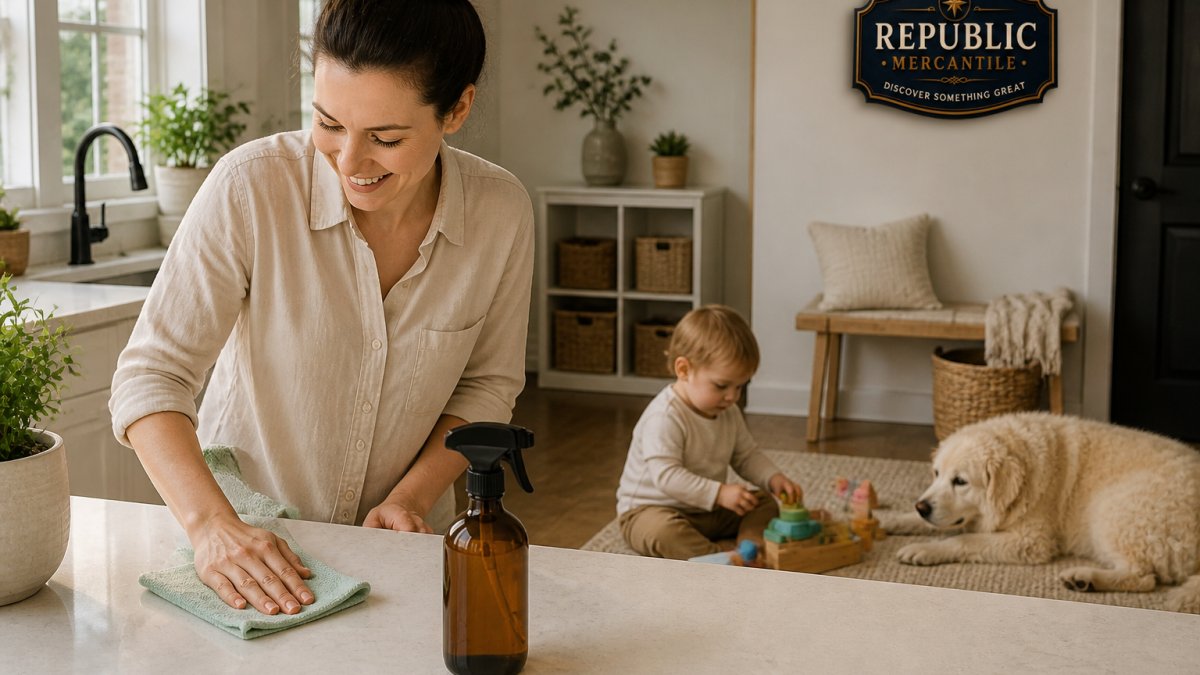
How Babies and Pets Actually Get Exposed
Understanding the exposure route changes what you buy and how you clean. For children under two, the dominant routes are:
- Hand-to-mouth transfer. A baby crawling on a freshly mopped floor, then putting a hand in their mouth, ingests whatever residue is left. This is why "wipe and let air-dry" is not always enough on floors.
- Surface-to-food contact. Food dropped on a counter or high-chair tray picks up residue. Rinsing or a damp wipe after cleaning matters more than the cleaner itself.
- Inhalation of volatiles. Vapors from sprays and aerosols concentrate at floor level, exactly where a crawling baby breathes. Ventilation and switching from spray to pour-and-wipe reduce this.
- Dermal absorption through paws. Dogs and cats groom their paws and coats, so anything on the floor becomes something they ingest. Cats are especially vulnerable because they lack certain liver enzymes (glucuronyl transferase) that help process many chemicals, including some essential oils.
Age-Specific Safety Guidelines
For babies (0-12 months): Their lungs and liver are still developing, and their skin is thinner and more permeable.
For toddlers (1-3 years): Toddlers crawl, climb, and taste-test everything. Choose cleaners low in acute toxicity if a small amount is ingested, and store every product, including "natural" ones, in a latched cabinet or on a high shelf.
For older children (4+ years): Kids this age can follow rules and even help clean.
Storage and Handling Rules That Actually Prevent Accidents
Most childhood poisonings from cleaners happen when a product is in use, not stored, a bottle left on a counter during a phone call, a bucket within reach during mopping. Practical habits:
- Keep the bottle in your hand or on a high surface during the entire cleaning task; never set it on the floor "just for a second."
- Never transfer cleaner into a food or drink container. A spray bottle of vinegar-water looks like water; a squeeze bottle of dish soap looks like juice.
- Store concentrates separately from ready-to-use bottles, and keep the original label on every container.
- Post the national Poison Control number (1-800-222-1222) on the fridge. It is free, confidential, and staffed 24/7.
Pet-Safe Cleaning Without Harmful Residue
Pets lick floors and absorb chemicals through their paws and skin. Many common household cleaners are toxic to dogs and cats, and several "natural" ingredients are on that list.
When choosing products for homes with pets, avoid:
- Essential oils, especially tea tree, eucalyptus, peppermint, citrus (d-limonene), pine, and wintergreen. Cats are particularly sensitive; even diffused oils can cause drooling, wobbliness, and liver stress.
- Phenols and cresols, found in some disinfectants and "pine" cleaners.
- Benzalkonium chloride and other quaternary ammonium compounds, common in disinfecting wipes and sprays; ingestion can cause mouth irritation, drooling, and vomiting in pets.
- Bleach-based cleaners, even diluted, on floors where pets walk.
Instead, use plant-based cleaners without essential oils, or simple vinegar-and-water solutions. After cleaning, rinse or damp-wipe surfaces so your pet doesn't walk through residue and lick their paws. For litter boxes, food bowls, and water bowls, use hot water and mild unscented soap, then rinse thoroughly.
Non-Toxic All-Purpose Cleaner Options and How to Use Them
An all-purpose cleaner is your workhorse, handling kitchen counters, bathroom tiles, glass, and wood without requiring three different products.
Multi-Surface Cleaners for Kitchen and Bathroom
The best non-toxic all-purpose cleaners for families use plant-based surfactants and mild acids like citric acid or vinegar to cut grease and soap scum without streaks or residue.
For tough kitchen grease or bathroom soap scum, spray the cleaner, let it sit for 30 seconds, and wipe. The waiting time lets it break down grime without aggressive scrubbing.
One budget-friendly approach: buy a concentrate and dilute it yourself, it goes further and reduces packaging waste. Republic Mercantile's 3-Packs of 10 (30 towels) Choicy Microfiber Cleaning Cloths at $17.95 are reusable and washable, and they trap dirt and bacteria better than cotton, so you use less cleaner overall.
Professional Window Squeegee & Scrubber Cleaning Tool →

Disinfection vs. Routine Cleaning: What You Actually Need
Many families overspend by assuming every surface needs disinfection, when most daily cleaning just removes dirt and dust.
Routine cleaning removes visible dirt, dust, and food residue, what you do daily on kitchen counters, bathroom sinks, and floors.
Disinfection kills germs and bacteria. You need it after someone's been sick, after handling raw meat, or on high-touch areas like doorknobs during cold season.
For families with babies and pets, this distinction matters. You're not constantly exposing them to disinfectant fumes. You're using them strategically when necessary.
Refillable Cleaning Products and Budget-Friendly Alternatives
Non-toxic doesn't have to mean expensive. Several strategies cut costs while reducing waste.
Cost Per Use: Making Non-Toxic Cleaners Affordable
Concentrate-based cleaners offer the best value: buy a small bottle, dilute with water, and get several bottles' worth, dropping cost per use dramatically versus pre-diluted bottles.
DIY solutions are even cheaper. Vinegar and water costs pennies per batch and handles most everyday cleaning; add a few drops of dish soap for greasy surfaces. Baking soda mixed with water becomes a gentle scrub for sinks and tubs.
The trade-off: DIY solutions require more effort and don't work on every surface, perfect for daily cleaning, less ideal for heavy-duty disinfection.
Reusable Tools That Reduce Waste and Save Money
Microfiber cloths stretch your budget: they absorb more liquid than cotton, so you use less cleaner per surface, and they're washable and reusable hundreds of times.
Republic Mercantile's microfiber cleaning cloths come in a 30-pack for $17.95, about 60 cents per cloth, each lasting months of regular washing, versus paper towels used once and thrown away.
For scrubbing power without harsh chemicals, the 2-Pack of S.O.S-Steel Wool Soap Pads, 10 Ct (20 Total) at $15.99 offers reusable scrubbing with built-in soap, a natural abrasive for pots, pans, and tough stains that rinses and reuses multiple times.

For windows and glass, the Professional Window Squeegee & Scrubber Cleaning Tool at $8.99 is a one-time investment that lasts years: the scrubber removes dirt and the squeegee blade wipes away water for streak-free results, no paper towels needed.

| Tool | Price | Best For | Cost Per Use |
|---|---|---|---|
| Microfiber Cloths (30-pack) | $17.95 | Daily cleaning, multiple surfaces | ~$0.60 per cloth, reusable hundreds of times |
| Steel Wool Soap Pads (20-pack) | $15.99 | Scrubbing pots, pans, tough stains | ~$0.80 per pad, reusable 5-10 times |
| Window Squeegee & Scrubber | $8.99 | Windows and glass | One-time investment, lasts years |
Common Mistakes to Avoid When Switching to Non-Toxic Cleaners
When families first switch to non-toxic home cleaning products for families, a few pitfalls trip them up.
Mistake 1: Expecting identical results without adjustment. Non-toxic cleaners work differently than harsh chemicals, sometimes needing more contact time or elbow grease on heavily soiled surfaces.
Never mix cleaning products, especially vinegar or baking soda with bleach or ammonia. The chemical reaction creates chlorine gas, which is dangerous even in small amounts. Stick to one product per cleaning task.
Mistake 3: Assuming all "natural" products are safe for babies and pets. Some plant-based ingredients are toxic to pets. Essential oils, for example, are natural but harmful to dogs and cats. Read the full ingredient list, not just the marketing label.
Mistake 4: Buying too many specialty products. You don't need a different cleaner for every surface. A good all-purpose non-toxic cleaner handles 80% of household cleaning.
Mistake 5: Not ventilating after cleaning. Even non-toxic cleaners can leave fumes.
Switching to non-toxic home cleaning products for families is an investment in your family's long-term health. Shop our selection of microfiber cloths, reusable scrubbers, and cleaning tools to build a non-toxic cleaning routine that works for your family. SHOP NOW
Frequently Asked Questions
What makes a cleaning product truly non-toxic and safe for families?
Non-toxic cleaning products use plant-based ingredients rather than harsh chemicals like ammonia, bleach, or synthetic fragrances. Look for products listing all ingredients transparently and avoiding known irritants. Safety for families means the product won't cause skin irritation, respiratory problems, or harm if accidentally ingested by children or pets. Check for certifications from independent testing organizations and avoid products with artificial dyes or preservatives that can trigger sensitivities.
Are natural cleaning products always non-toxic and effective?
Not necessarily. Natural ingredients can still cause reactions in sensitive individuals, and some plant-based cleaners may not disinfect as thoroughly as needed for bathrooms or kitchens. Effective non-toxic cleaners combine plant-derived ingredients with proper formulation for the job, an all-purpose cleaner works differently than a disinfectant. Always check the product label for what it's designed to do and whether it's suitable for your specific cleaning needs and family situation.
How can I tell if a household cleaner is safe for children and pets?
Check the ingredient list for harmful chemicals like ammonia, bleach, phthalates, and parabens. Look for products labeled as non-toxic, plant-based, or hypoallergenic. Ensure the cleaner is fragrance-free or uses natural essential oils rather than synthetic fragrances. For babies specifically, use cleaners rated safe for nurseries. For pets, avoid anything toxic if ingested. Always store cleaners out of reach and rinse surfaces thoroughly after cleaning to prevent residue contact with crawling babies or pets that lick surfaces.
What's the difference between disinfection and routine cleaning for families?
Routine cleaning removes dirt and grime using non-toxic all-purpose cleaners, which is sufficient for daily household surfaces. Disinfection kills germs and bacteria, necessary only in bathrooms, kitchens, and when someone is sick. Most families don't need disinfectants daily, regular non-toxic cleaners handle everyday cleaning effectively. For families with young children or immunocompromised members, choose non-toxic disinfectants when needed, but understand they're not required for every surface every day.