

Table of Contents
- What to Look for When Buying High Quality Jewelry
- Understanding Metal Hallmarks and Stamps
- How to Tell If Jewelry Is Real Gold
- The Difference Between Gold-Plated and Gold-Filled Jewelry
- Inspecting Prongs and Setting Quality
- How to Inspect Gemstone Quality
- Using a Jeweler's Loupe for Detailed Inspection
- Identifying Authentic Certifications and Appraisals
Last Updated: August 28, 2026
What to Look for When Buying High Quality Jewelry
Knowing how to spot high quality jewelry is one of the most practical skills you can develop as a shopper. Whether you're browsing online at Republic Mercantile or examining pieces in person, the ability to distinguish genuine craftsmanship from mass-produced imitations saves money and prevents buyer's remorse. This guide walks you through the exact methods jewelers use to evaluate quality, hallmarks, metal testing, prong settings, and certifications, so you can make informed decisions with confidence.
Understanding Metal Hallmarks and Stamps
Every legitimate piece of precious metal jewelry carries a hallmark, a small stamped mark that identifies the metal type and purity. These stamps are your first line of defense against counterfeits.
Hallmarks indicate metal composition and purity. For gold, you'll see numbers like 10K, 14K, 18K, or 24K, representing the percentage of pure gold in the alloy. 24K is pure gold (99.9%), while 18K contains 75% gold, 14K contains 58.3%, and 10K contains 41.7% (the FTC). Sterling silver carries a "925" stamp, meaning 92.5% pure silver with 7.5% other metals for durability (the FTC). Platinum is typically stamped "950 Plat" or "Pt950," indicating 95% platinum.
Location matters when checking hallmarks. On rings, look inside the band. On bracelets and necklaces, check near the clasp or along the chain. Earrings should have marks on the post or back. If a piece claims to be precious metal but has no hallmark, walk away.
How to Tell If Jewelry Is Real Gold
Gold jewelry is one of the most counterfeited precious metals because the difference between real and fake isn't always obvious. Several practical tests help you distinguish genuine gold from imposters.
The Magnet Test
A simple magnet reveals whether jewelry contains ferrous metals, which shouldn't be present in genuine precious metal jewelry. Real gold, silver, and platinum are non-magnetic. Take a strong neodymium magnet and hold it near the jewelry without touching. If the piece moves toward the magnet or sticks to it, the metal composition is questionable. Real gold jewelry will not react at all.
The Float Test
Water displacement reveals the density of metal, and precious metals have specific gravity ranges that fakes rarely match. Fill a glass with water and carefully place the jewelry inside. Real gold is dense and will sink immediately to the bottom. Gold-plated pieces or jewelry made from cheaper metals often float or sink slowly because the base metal has lower density.
The Difference Between Gold-Plated and Gold-Filled Jewelry
Understanding these distinctions matters because they affect both price and longevity.
Gold-plated jewelry has a thin layer of gold bonded to a base metal. The gold layer is typically 0.5 to 2.5 microns thick, applied through electroplating. This makes gold-plated pieces significantly less expensive, but the plating wears away with regular wear within months or a few years, exposing the base metal underneath.
Gold-filled jewelry contains a thicker layer of gold mechanically bonded to a base metal core. Federal regulations require that gold-filled jewelry contain at least 1/20 of the item's weight as gold (the FTC). Gold-filled pieces can last 10-30 years with normal wear, though the base metal eventually shows through in high-friction areas.
Solid gold contains no base metal core. It's gold throughout, mixed with other metals to achieve the desired karat weight. Solid gold doesn't wear away, making it the most durable and longest-lasting option, though also the most expensive.
For budget-conscious shoppers, Republic Mercantile offers handcrafted silver-plated options like the Handcrafted, Silver Plated Bangle Gem Bracelet at $12.95, which delivers style without the premium price of solid precious metals. When evaluating gold-plated or gold-filled jewelry, ask the seller directly about the thickness of the gold layer and the base metal composition.

Inspecting Prongs and Setting Quality
The prongs that hold gemstones in place reveal enormous amounts about overall craftsmanship. Quality prongs should be smooth, evenly spaced, and securely holding the stone. Look for these specific indicators:
- Prongs should be uniform in thickness and height. Inconsistent prongs suggest rushed work.
- Solder joints where prongs attach to the setting should be smooth and even. Rough or lumpy solder indicates poor metalwork.
- The stone should not move or wiggle. A secure stone doesn't budge when gently pressed.
- No gaps should exist between the prong and the stone. Light should not pass through any space between them.
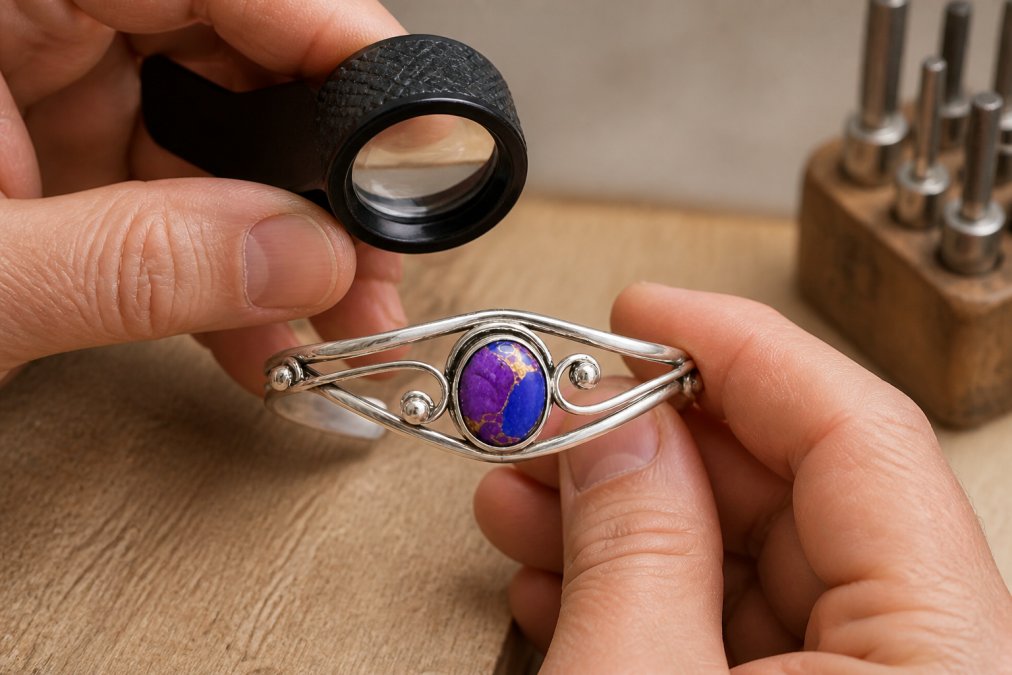
Four-prong settings are standard for round stones and offer good security. Six-prong settings provide even more stability. Bezel settings, where metal wraps around the stone's edge, offer maximum protection. Filigree work or decorative elements should be crisp and well-defined. When examining jewelry, take time to inspect the setting area closely, this single element often determines whether a piece will last decades or fail within years.
How to Inspect Gemstone Quality
Gemstone quality affects both the jewelry's visual appeal and its value. The four factors jewelers use are cut, color, clarity, and carat weight. Cut refers to how well the stone's facets are shaped and proportioned, affecting how light reflects through it. Color ranges from completely colorless (most valuable for diamonds) to various hues. Clarity measures the presence of inclusions or blemishes. Carat weight measures the stone's size and mass.
When evaluating gemstones, ask whether the stone is natural, synthetic, or a simulant. Natural gemstones form in the earth over millions of years. Synthetic gemstones are created in laboratories with identical chemical composition but without the time investment. Simulants like cubic zirconia or glass look similar but have different composition and durability.
Using a Jeweler's Loupe for Detailed Inspection
A jeweler's loupe is a small magnifying lens that reveals details invisible to the naked eye. A 10x magnification loupe (the standard) costs between $10 and $30 and lasts indefinitely.
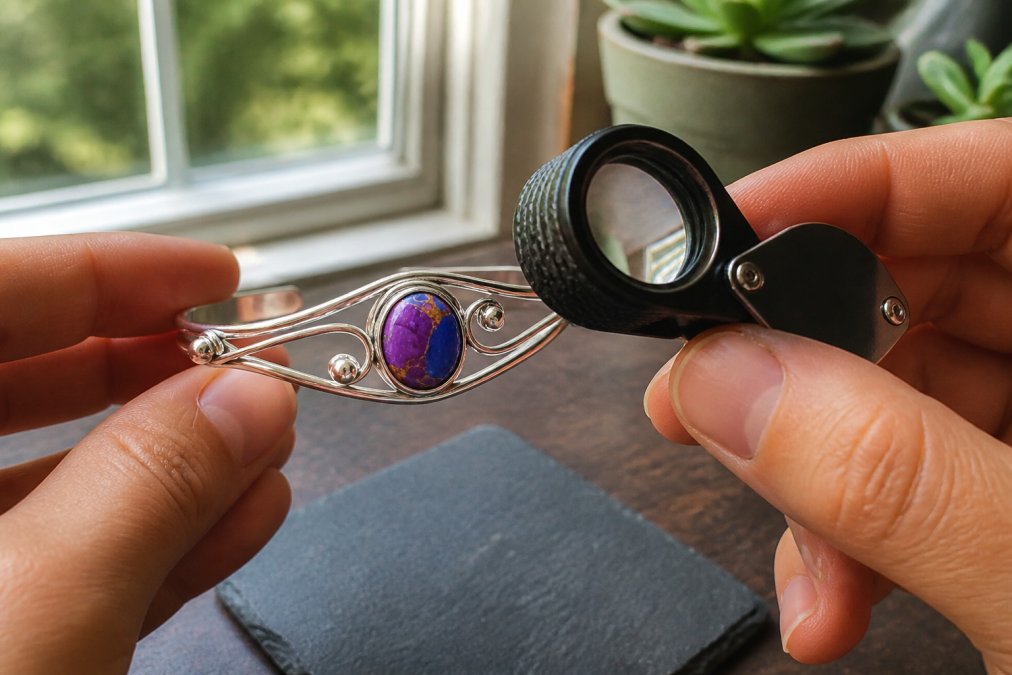
Hold the loupe close to your eye, then bring the jewelry toward it until the image comes into focus. Examine the stone from multiple angles, looking at the table (top surface), the crown (upper facets), the pavilion (lower facets), and the girdle (widest part). With magnification, you can assess clarity far more accurately and inspect the prongs and setting thoroughly, spotting solder imperfections, bent prongs, or gaps between metal and stone. Examine the metal surfaces as well, quality precious metals should have smooth, even finishes. The hallmark becomes much clearer under magnification too, allowing you to verify the exact stamp.
Identifying Authentic Certifications and Appraisals
Certifications from recognized laboratories provide third-party verification of gemstone quality and precious metal composition. The Gemological Institute of America (GIA) is the most widely recognized and respected gemstone certification lab. A GIA certificate includes detailed assessments of the stone's cut, color, clarity, and carat weight, along with identification of treatments or enhancements. GIA certificates are difficult to counterfeit and can be verified online through the GIA website.
Other reputable labs include the American Gem Society (AGS) and the International Gemological Institute (IGI). Be cautious of lesser-known labs or generic "appraisals" from local jewelry stores, as these lack the standardization of major labs.
When evaluating a certificate, verify its authenticity by checking the lab's website. Most major labs allow you to enter the certificate number and retrieve the original report. Also confirm that the certificate matches the physical jewelry you're examining. Be aware that not all jewelry comes with certificates, and the absence of a certificate doesn't mean the jewelry is fake. However, for expensive purchases (generally above $500-$1,000), requesting a certificate is reasonable.
When you're ready to add quality jewelry to your collection, start with these evaluation techniques. Examine hallmarks, test with magnets, inspect prongs and settings, and use a loupe to spot imperfections. Republic Mercantile makes it easy to find handcrafted pieces like the Divine Designs Handcrafted Charm Bracelet at $14.95, created with genuine attention to detail. These pieces combine quality craftsmanship with affordable pricing, giving you confidence that your jewelry investment will last.

Frequently Asked Questions
How can I tell if jewelry is high quality when shopping online?
Start by examining product photos for visible hallmarks, clear gemstone settings, and smooth metalwork. Request close-up images showing prongs and solder joints. Check for seller certifications, detailed product descriptions mentioning karat weight or metal type, and customer reviews mentioning durability. Reputable sellers provide magnified photos and accurate metal composition details. For pieces like our handcrafted silver-plated bangle gem bracelets, verify the plating thickness and gemstone clarity are clearly documented.
What is the difference between gold-plated and gold-filled jewelry?
Gold-plated jewelry has a thin layer of gold bonded to a base metal, typically lasting 1-3 years with regular wear before the plating may show wear. Gold-filled jewelry contains 5-10% gold by weight bonded to base metal and generally lasts longer. Gold-filled is significantly more durable and maintains its appearance longer. For budget-conscious buyers seeking lasting quality, gold-filled offers better long-term value, though gold-plated remains affordable for occasional wear.
How do I know if gemstones in jewelry are real or synthetic?
Real gemstones have natural inclusions visible under a jeweler's loupe, while synthetics can appear too perfect. Check the price point, if a large, clear gemstone costs suspiciously low, it's likely synthetic or simulated. Real gemstones have weight and density that feel substantial; simulants may feel lighter. Request a gemstone report from the seller detailing clarity, cut, and color. Natural stones often show slight color variations, while synthetics may have uniform coloring. Authentic certifications from recognized labs confirm gemstone authenticity and quality.
What should I look for in hallmarks and stamps?
Hallmarks indicate metal purity: '925' means sterling silver (92.5% pure), '14K' means 14-karat gold (58.3% pure), and '18K' means 18-karat gold (75% pure). Look for maker's marks or assay office stamps confirming authenticity. The hallmark should be clean, crisp, and consistent with the metal type. Absence of hallmarks on precious metal jewelry is a red flag. Sterling silver items should always display the 925 stamp. Hallmarks provide important information about the jewelry's composition.
This article was written using GrandRanker