

Quick Summary
A home tool kit should include a claw hammer, screwdriver set, slip-joint pliers, needle-nose pliers, adjustable wrench, tape measure, utility knife, and flashlight or headlamp. These core tools handle most repairs new homeowners face in their first year, and a basic starter kit can cost about $12.95.
- Start with eight core tools: hammer, screwdrivers, two pliers, adjustable wrench, tape measure, utility knife, and light.
- Buy sizes that match your fasteners, since a 2 Phillips and 1/4-inch flathead cover most household screws.
- Add a small set of 8 and 10 wood screws, drywall anchors, and machine screws to avoid store trips.
- Wait on a drill and larger socket sets until specific projects call for them.
- Call a licensed professional for gas lines, main electrical panels, structural walls, or major plumbing.
Table of Contents
- Why New Homeowners Need a Basic Tool Kit
- What Belongs in a Starter Home Tool Kit
- Home Tool Kit with Drill: When the Upgrade Makes Sense
- Must-Have Hand Tools for Repairs
- Republic Mercantile Kits Compared by Budget and Task
- How to Organize a Home Toolbox So Tools Stay Usable
- Choosing Your First Kit and Adding Tools Over Time
- Frequently Asked Questions
Why New Homeowners Need a Basic Tool Kit
Last Updated: November 2, 2026
A home tool kit is the first purchase most new homeowners should make, and it pays off within the first month. Hanging a shelf, tightening a loose cabinet hinge, and assembling a bed frame all go faster with the right tools on hand. Many first-time owners discover, usually mid-task, that they have no screwdriver small enough for the job.
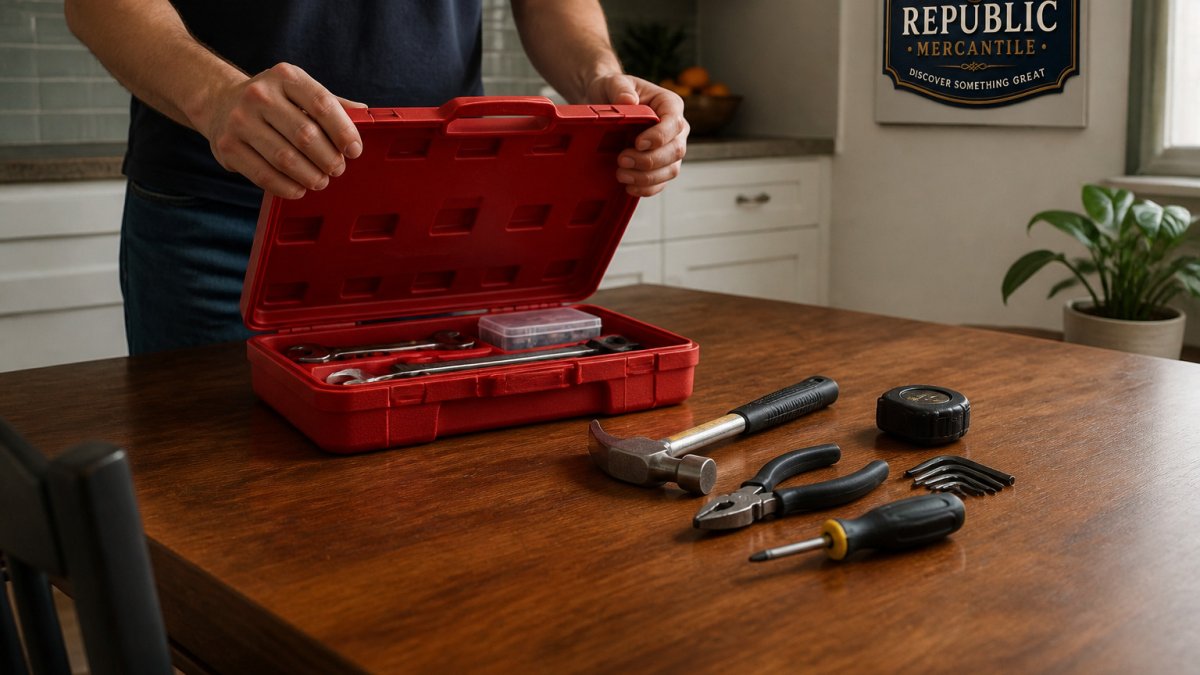
A compact starter set covers the everyday jobs that come up in the first year of ownership.
The goal is not a full workshop. It is a small, organized collection that handles the repairs you will face in the first few months, without cluttering a closet or drawer.
What Belongs in a Starter Home Tool Kit
A useful starter kit covers four jobs: driving and removing screws, gripping and turning, measuring and marking, and cutting or hanging. Most homeowners need a Phillips and flathead screwdriver, a pair of pliers, a tape measure, and a hammer as the core. From there, a small set of additions rounds out the kit so it handles the first-year repair list without a trip to the store mid-task.
The core eight tools. A starter kit works best when it includes:
- Claw hammer (16 oz), driving and pulling nails, tapping in picture hangers, and light demolition. The claw is the part that earns its keep; a hammer without a sturdy claw is a paperweight.
- Screwdriver set (Phillips and flathead, multiple sizes), cabinet hardware, outlet covers, furniture assembly, and toy batteries. Sizes matter more than count; a #2 Phillips and a 1/4-inch flathead cover most household fasteners.
- Slip-joint pliers, gripping nuts, holding a fitting steady, and pulling a stubborn nail. The two-position jaw adjusts for larger and smaller work.
- Needle-nose pliers, reaching into tight spaces, bending wire, and holding small parts. Useful for hanging a picture wire or retrieving a dropped screw from a drain.
- Adjustable wrench, turning nuts and bolts on plumbing fixtures, furniture, and appliances. One adjustable wrench replaces a drawer of fixed-size wrenches for light home use.
- Tape measure (25 ft), measuring for shelves, furniture placement, and picture height. A 25-foot blade covers most rooms; a 12-foot is fine for an apartment.
- Utility knife, opening boxes, trimming caulk, cutting drywall, and scoring material. Retractable blades are safer to store.
- Flashlight or headlamp, working under a sink, in a closet, or in a breaker panel. A headlamp keeps both hands free, which matters more than brightness for most home tasks.
The small parts that save a trip. A starter kit should also include a small assortment of fasteners: #8 and #10 wood screws in 1-inch and 1-1/2-inch lengths, drywall anchors, and a few machine screws. These are the pieces that turn a five-minute fix into a store run when they are missing. A divided case keeps them sorted.
What you can skip at first. A full socket set, a level longer than 2 feet, and a stud finder are useful but not essential in month one. Add them when a specific project calls for them rather than buying a large set you rarely open.
The 9 Piece Home Tool Set with Case at $12.95 includes its own carry case, so everything stays in one place. It is designed for new homeowners, students, or anyone who wants a compact starter set. You can browse the 9 piece home tool set with case to see what it includes.

Choose a kit with clear contents and a case you will actually use. A set with the right core tools beats a large set with items you never touch.
Match the kit to the home. An apartment with mostly drywall and furniture assembly needs the core eight plus a stud finder. An older home with original plumbing and doors benefits from the adjustable wrench and slip-joint pliers first. A larger property with a garage or shed justifies the 46-piece set sooner. The kit should follow the repairs you actually face, not the shelf space you have.
Home Tool Kit with Drill: When the Upgrade Makes Sense
A drill is the most common next step after a basic kit. It handles mounting brackets, anchoring shelves into studs, and driving longer screws without strain. Most homeowners should wait until they have a few specific projects that need one.
If you plan to hang heavy items or build furniture regularly, a drill-based home tool kit saves time and effort. Check whether the kit includes a drill or whether you need to buy one separately, since that changes the total cost.
For light use, a manual screwdriver set covers most small fixes. Add a drill when repeated driving becomes the bottleneck.
Must-Have Hand Tools for Repairs
Hand tools handle the small, frequent repairs that come up in any home: tightening a loose cabinet pull, adjusting a door hinge, or fixing a toilet seat. A dedicated screwdriver set is the single most useful item for these jobs, but it is not the only one.
| Tool | Common first-year jobs | What to check before buying |
|---|---|---|
| Screwdriver set (Phillips and flathead) | Cabinet hardware, outlet covers, furniture assembly, toy batteries | Multiple sizes per head type; a #2 Phillips and 1/4-inch flathead cover most fasteners |
| Claw hammer (16 oz) | Hanging pictures, tapping in nails, light pry work | A forged steel head and a claw that does not flex |
| Slip-joint pliers | Holding a fitting, gripping nuts, pulling a nail | Two-position jaw; cushioned handles |
| Needle-nose pliers | Bending wire, reaching tight spaces, holding small parts | A fine tip that closes flush |
| Adjustable wrench | Plumbing fixtures, furniture bolts, appliance connections | A jaw that holds its setting under load |
| Tape measure (25 ft) | Shelves, furniture placement, picture height | A blade lock and a hook that stays true |
| Utility knife | Opening boxes, trimming caulk, scoring drywall | Retractable blade and a spare-blade storage slot |
| Hex key set (Allen wrenches) | Furniture assembly, bicycle adjustments, faucet handles | Metric and SAE sizes; most flat-pack furniture uses metric |
| Flashlight or headlamp | Under-sink work, closets, breaker panel | A headlamp keeps both hands free |
Screwdrivers first. Our 10 Piece Screwdriver Set for Home or Office at $9.98 is a compact set designed for home or office use. You can see the 10 piece screwdriver set if you want a dedicated set for repair work.

Watch out: forcing a screwdriver with the wrong size tip strips the screw head, which turns a five-minute fix into a drilling job. Match the tip to the screw before you apply pressure.
9 Piece Home Tool Set with Case →
Pliers and wrenches next. Slip-joint pliers and an adjustable wrench cover the gripping and turning jobs a screwdriver cannot. A common pattern is a homeowner who owns three screwdrivers and no wrench, then cannot tighten a loose faucet nut or a furniture bolt. Buy the wrench before the third screwdriver.
Measuring and cutting. A tape measure and a utility knife handle the jobs that start every project: measuring for a shelf and opening the box the shelf came in. Keep the tape measure in the kit rather than a junk drawer so it is there when you need it.
Hex keys for flat-pack furniture. Most flat-pack furniture uses metric hex bolts, and the included key is often soft metal that rounds off under pressure. A dedicated hex key set in metric and SAE sizes prevents that frustration and costs less than replacing a stripped bolt.
Safety and when to call a professional. Eye protection and work gloves are worth keeping with the kit; safety glasses cost a few dollars and prevent the most common home-repair injury. Before any electrical work, turn off the breaker at the panel and verify it is off.
Republic Mercantile Kits Compared by Budget and Task
The right kit depends on your budget and the jobs you expect. Here is how our current kits compare on price and scope:
| Kit | Starting Price | Best For |
|---|---|---|
| 9 Piece Home Tool Set with Case | $12.95 | Basic household fixes and first-year setup |
| 13 Piece Lady's Home Tool Kit | $12.95 | Everyday repairs and picture hanging |
| 10 Piece Screwdriver Set | $9.98 | Dedicated screwdriver work |
| 46 Piece Tool Set (1/4" Quick-Release Ratchet) | $15.98 | Broader projects, including automotive and bicycle tasks |
The 46 Piece Tool Set with its 1/4" quick-release ratchet is the largest option at $15.98. It includes socket attachments, extensions, and other tools for a range of projects. The red-case version is a color variant of the same set.
If you have a tight budget, start with the $9.98 screwdriver set or the $12.95 starter kits. If you expect a wider range of tasks, the 46-piece set gives more coverage for a few dollars more.
How to Organize a Home Toolbox So Tools Stay Usable
A well-organized toolbox saves more time than an expensive one. Group tools by job: fasteners together, measuring tools together, and cutting tools in their own compartment. Keep the screwdriver bits in the same case so you do not hunt for the right one mid-task.
Store the kit somewhere easy to reach, such as a hall closet or under the sink if it fits. A case with fitted slots keeps tools from rattling and getting lost. Check the kit once or twice a year to replace missing bits and clean any rust.
Label the case or the drawer if you share the kit with others in the household. A simple inventory list taped inside the lid helps you spot missing pieces before a project starts.
Choosing Your First Kit and Adding Tools Over Time
Start with a kit that covers the basics and matches your budget. A $12.95 starter kit or a $9.98 screwdriver set gives you a working foundation without a large outlay. Add tools as specific projects call for them.
Many new homeowners buy a large set they rarely open. A better approach is to note each repair you make and add the tool that would have made it easier. Over a year, that list shows you exactly what your home needs.
Once you know your habits, you can move up to a larger set such as the 46-piece option. Before deciding, you can compare a compact beginner-friendly option against the larger sets.

Frequently Asked Questions
What is the best tool kit for a first-time homeowner?
For most first-time homeowners, a compact starter set with a hammer, screwdrivers, pliers, a tape measure and a utility knife covers the bulk of minor repairs and furniture assembly. Republic Mercantile's 9 Piece Home Tool Set with Case is priced at $12.95 and includes a carry case, which makes it a low-risk first purchase. Once you know which jobs you repeat most, you can add specialized tools instead of buying a larger kit you may not use.
What tools does every new homeowner need?
Every new homeowner should have a claw hammer, a set of Phillips and flathead screwdrivers, adjustable and needle-nose pliers, a tape measure, a utility knife and a flashlight. These cover hanging pictures, tightening fixtures, measuring for shelves and handling small cuts. The 13 Piece Lady's Home Tool Kit at $12.95 includes a claw hammer, precision screwdrivers, a measuring tape and pliers in one case.
Should I buy a pre-made tool kit or build my own?
A pre-made kit is usually the cheaper and faster route, because the contents are matched and stored together. Building your own lets you pick higher-quality individual tools for the jobs you expect most often. A practical middle path is to start with a kit such as the 10 Piece Screwdriver Set for Home or Office at $9.98, then add single tools as specific needs come up.
Is a home tool kit with drill worth it for beginners?
A drill is worth adding once you regularly need to drive screws into wood, masonry or drywall, which most new homeowners do within the first year. Hand tools handle small fixes, but a drill saves time on mounting shelves, installing curtain rods and assembling furniture. If you are not sure yet, start with a hand-tool kit and add a drill later rather than paying for power tools you may use rarely.
