

Table of Contents
- What Does 'Tarnish-Free' Actually Mean for Gold Jewelry?
- Quick Comparison: Affordable Gold Jewelry That Does Not Tarnish
- Gold-Plated vs. Gold-Filled Jewelry: What's the Difference?
- Stainless Steel and PVD Coatings: The Budget-Friendly Tarnish-Free Option
- Affordable Real Gold Jewelry: When 10K and 14K Make Sense
- How to Care for Gold-Plated Jewelry So It Lasts
- Our Top Picks: Tarnish-Resistant Gold Jewelry Under $20
- Frequently Asked Questions
Last Updated: October 12, 2026
What Does 'Tarnish-Free' Actually Mean for Gold Jewelry?
Tarnish-free gold jewelry is jewelry whose surface resists the dulling, darkening, or discoloration that happens when metal reacts with air, moisture, sweat, and everyday chemicals. The term describes a finish or a metal base that holds its gold color through normal wear, not a piece that never ages at all.
This distinction matters because "tarnish-free" gets used loosely. At Republic Mercantile, we see shoppers assume it means the same thing as "solid gold," and it does not. It simply means the piece you buy today should still look gold next month, even after a shower or a workout.
Below, we break down what actually resists tarnish, what does not, and how to spend wisely on affordable gold jewelry that does not tarnish. The short version: the metal base and the coating decide everything.
Quick Comparison: Affordable Gold Jewelry That Does Not Tarnish
The fastest way to choose is to match the construction to how you wear the piece. Plated jewelry is the cheapest up front but needs the most care. Stainless steel with a gold tone finish costs a few dollars more and shrugs off water and sweat.

| Type | Water & Sweat | Typical Wear Life | Best For | Price Range |
|---|---|---|---|---|
| Gold-plated | Avoid prolonged contact | Months of daily wear | Occasional dress-up | Lowest |
| Gold-filled | Tolerates light contact | Years | Daily wear on a budget | Mid |
| Solid 10K-14K gold | Fully tolerant | Decades | Heirloom pieces | Highest |
| Stainless steel, gold tone | Fully tolerant | Years | Everyday, active wear | Low |
Notice that the cheapest option is not the most durable, and the most durable is not the cheapest. That trade-off is the whole game with affordable gold jewelry.
Gold-Plated vs. Gold-Filled Jewelry: What's the Difference?
The difference comes down to how the gold is attached to the base metal and how thick that gold layer is. Gold-plated jewelry gets its gold layer through electroplating, where a current deposits a microscopic film of gold onto a base metal like brass, copper, or steel.
Thickness is where the two diverge in practice. Plating is measured in microns, and a typical fashion-plated piece sits in the 0.5 to 2.5 micron range. Gold-filled is measured as a fraction of the total metal weight, and the common industry standard is 1/20 by weight, meaning the gold layer is at least 5 percent of the piece's mass.
Vermeil is its own category, and it is worth knowing because it is often confused with gold-filled. Vermeil is a specific construction: a sterling silver base with a gold layer of at least 2.5 microns, and the gold must be at least 10 karat.
Solid gold has no layer to wear off because the gold alloy runs all the way through. That is why a solid 10K or 14K piece can be polished, resized, and repaired indefinitely, while a plated or filled piece cannot be restored once the gold layer is compromised.
Here is how the four constructions compare on the factors that actually drive longevity:
| Construction | How Gold Is Applied | Gold Thickness | Base Metal | Wear Life (Daily) |
|---|---|---|---|---|
| Gold-plated | Electroplated film | Roughly 0.5-2.5 microns | Brass, copper, steel | Months |
| Vermeil | Electroplated over sterling | At least 2.5 microns | Sterling silver | 1-3 years |
| Gold-filled | Heat-and-pressure bonded | At least 1/20 by weight | Brass or copper core | 3-10+ years |
| Solid gold | Alloy throughout | No layer | None | Decades |
- Gold-plated: thin electroplated layer, lowest cost, needs careful storage and dry wear
- Vermeil: plated over sterling silver, mid price, better base metal than brass
- Gold-filled: thick bonded gold layer, mid price, daily-wear friendly
- Solid gold: gold all the way through, no layer to wear off, repairable for life
A common pattern in the affordable segment is that sellers use "gold" as a color word rather than a material word. The Federal Trade Commission guidance on jewelry advertising sets out how gold content and plating claims are supposed to be described, and it is worth a read before you trust a listing that only says "gold."
Stainless Steel and PVD Coatings: The Budget-Friendly Tarnish-Free Option
Stainless steel resists tarnish on its own, and a gold tone finish adds the warm color without the fragility of plating over brass. That combination is why stainless steel has become the workhorse of affordable gold jewelry.

The metal itself does not rust or darken the way copper and brass do. A gold tone finish sits on top for color, and the underlying steel keeps the piece structurally sound even if the finish dulls over time. For anyone who wears rings, bracelets, or earrings through showers and workouts, this is the most forgiving category.
Our stainless steel pieces are also described as hypoallergenic, which matters if your skin reacts to nickel in cheaper base metals. The Nickel Institute overview of nickel and skin sensitivity explains how nickel release triggers most metal reactions, and why the base metal choice matters as much as the finish.
Affordable Real Gold Jewelry: When 10K and 14K Make Sense
Real gold jewelry means solid gold, not a coating, and 10-karat and 14-karat are the two purities that keep solid gold within reach. Karat describes gold content: 24K is pure, 14K is roughly 58 percent gold, and 10K is about 42 percent, with the rest made up of harder alloy metals.
That alloy content is not a flaw. Pure gold is soft and scratches easily, so mixing in other metals makes a ring or bracelet hold its shape through daily wear. The trade-off is color: 10K reads slightly paler than 14K, and both look warmer than a plated finish.
Buy solid gold when the piece is meant to last decades or be passed down. For a trend piece or a gift you want to swap out next season, the cost rarely justifies it. The Federal Trade Commission guidance on jewelry advertising is worth reading if you want to understand how gold content claims are supposed to be described on a label.
How to Care for Gold-Plated Jewelry So It Lasts
Caring for gold-plated jewelry comes down to three habits: keep it dry, keep it separate, and keep it clean with the gentlest method that works. Plating fails at the edges first, so anything that rubs or scrapes accelerates the wear. Understanding why it fails makes the habits easier to keep.
Plating is a thin electroplated film, and it wears through by two mechanisms. The first is abrasion: friction from skin, clothing, other jewelry, and surfaces rubs the gold layer thinner at the highest-contact points, which is why the inner edge of a ring or the clasp of a bracelet usually shows base metal first.
Stainless Steel Gold Tone Band Ring Size 8 →
That is why the care routine is built around reducing both. Here is what actually helps:
- Take plated pieces off before showering, swimming, or heavy sweating
- Store each piece in its own pouch or compartment so clasps do not scratch neighbors
- Wipe with a soft dry cloth after wearing to remove oils and residue
- Skip abrasive polishes and ultrasonic cleaners, which strip the thin gold layer
- Put jewelry on last when getting ready, after lotions and perfume dry
- Keep plated pieces out of the bathroom, where humidity accelerates tarnish
Chlorine and salt water are the two fastest ways to dull a plated finish, which is why we tell customers to treat pool and ocean days as "take it off" days. Stainless steel pieces handle that exposure far better, so save the plated pieces for dry, low-contact occasions.
If a plated piece does discolor, the first step is to identify whether the gold layer is gone or just dirty. A soft dry cloth removes surface oils and often restores the shine. If the color is still uneven after a gentle wipe, the plating has likely worn through at that spot, and no cleaning product will bring it back. Do not reach for silver polish, baking soda paste, or toothpaste, all three are abrasive enough to remove more of the remaining gold.
This is where total cost of ownership matters. A plated piece that costs a few dollars and lasts a season is a reasonable buy if you treat it as disposable.
A practical routine for plated pieces is to wear them on dry, low-contact days, wipe them down the same evening, and store them individually. That single habit, wiping and separating, is the highest-return care step you can take, and it costs nothing.
Our Top Picks: Tarnish-Resistant Gold Jewelry Under $20
Everything below sits under $20 and uses stainless steel with a gold tone or rose gold tone finish, the construction we recommend most often for everyday affordability.
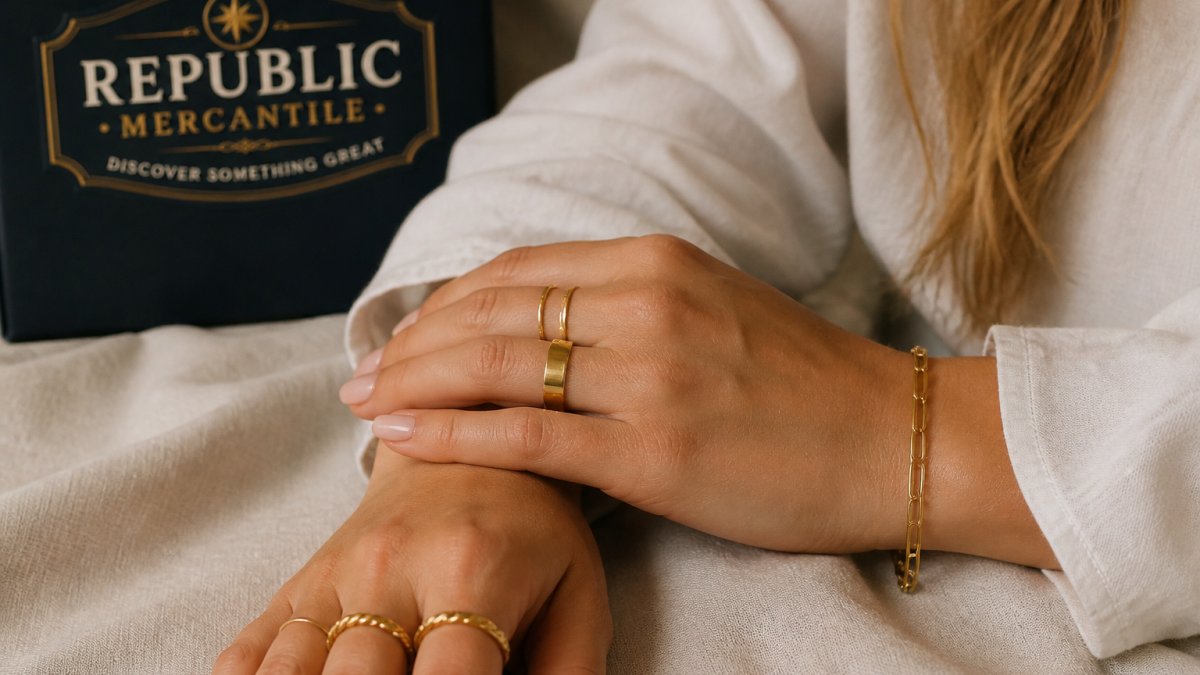
Stainless Steel Solid Band Ring, Gold Tone, 3mm, Size 6 at $4.79 is the entry point we point most people toward.
Stainless Steel Solid Band Ring, Rose Gold, 4mm, Size 6 at $4.99 swaps the yellow tone for a warmer rose finish at the same durability.
Stainless Steel Solid Band Ring, Gold Tone, 6mm, Size 9 and Size 10 at $6.49 each give you a wider band with more presence.

Stainless Steel Gold Tone Band Ring, Size 8 at $17.95 is the heavier, polished option. It resists tarnishing and scratching, and the smooth finish catches light well whether worn solo or stacked.
Stainless Steel Golden Ladies Christian Bracelet at $9.95 pairs a golden finish with a Christian motif, and the durable construction resists tarnishing and everyday wear. It layers easily or stands alone.
ProSteel 3" Hoop Gold Stainless Steel Earrings at $19.85 are the statement piece of the group.
To compare the whole set side by side, our jewelry collection at Republic Mercantile groups these by finish and size so you can match a set in one pass.
Frequently Asked Questions
What is the cheapest gold that won't tarnish?
Stainless steel with a gold-tone finish is the most budget-friendly option that resists tarnishing. Republic Mercantile offers stainless steel gold-tone band rings starting at $4.79. These rings resist tarnish and scratching, making them ideal for everyday wear. Solid 10K or 14K gold also won't tarnish, but costs significantly more. For under $20, stainless steel gives you the gold look without the maintenance worries.
Is gold-filled jewelry more tarnish-resistant than gold-plated jewelry?
Yes. Gold-filled jewelry has a thicker layer of real gold bonded to a base metal, so it resists tarnishing far longer than gold-plated pieces. Gold-plated jewelry has a thin gold coating that wears away with sweat, lotions, and friction. If you want affordable real gold jewelry that holds up, gold-filled is worth the higher price. For the lowest upfront cost, stainless steel with a gold-tone finish is another tarnish-resistant choice.
How can I make affordable gold jewelry last longer?
Follow a few simple habits to extend the life of your gold-plated jewelry. Put jewelry on last, after lotions and perfume have dried. Take it off before showering, swimming, or exercising. Wipe pieces with a soft cloth after wearing to remove oils and sweat. Store each item separately in a dry pouch or box. Republic Mercantile's stainless steel pieces resist tarnishing and scratching, so they need less maintenance than plated options.
Does gold-plated jewelry tarnish?
Gold-plated jewelry can tarnish over time. The thin gold layer wears down from contact with skin oils, sweat, lotions, and cleaning products. Once the base metal shows through, it may discolor or irritate sensitive skin. How long it lasts depends on the plating thickness and how often you wear it. For a longer-lasting alternative at a similar price point, stainless steel with a gold-tone finish resists tarnish and scratching.
The hard part of buying affordable gold jewelry that does not tarnish is not finding a low price. It is finding a low price attached to a construction that survives real wear. Republic Mercantile stocks stainless steel rings, bracelets, and earrings with gold and rose gold tone finishes, all under $20, plus new inventory added regularly and fast shipping so your picks arrive ready to wear. Browse the collection and build a stack that still looks gold six months from now.